Fashion retailBoutiques, labels and multi-channel brands · AU

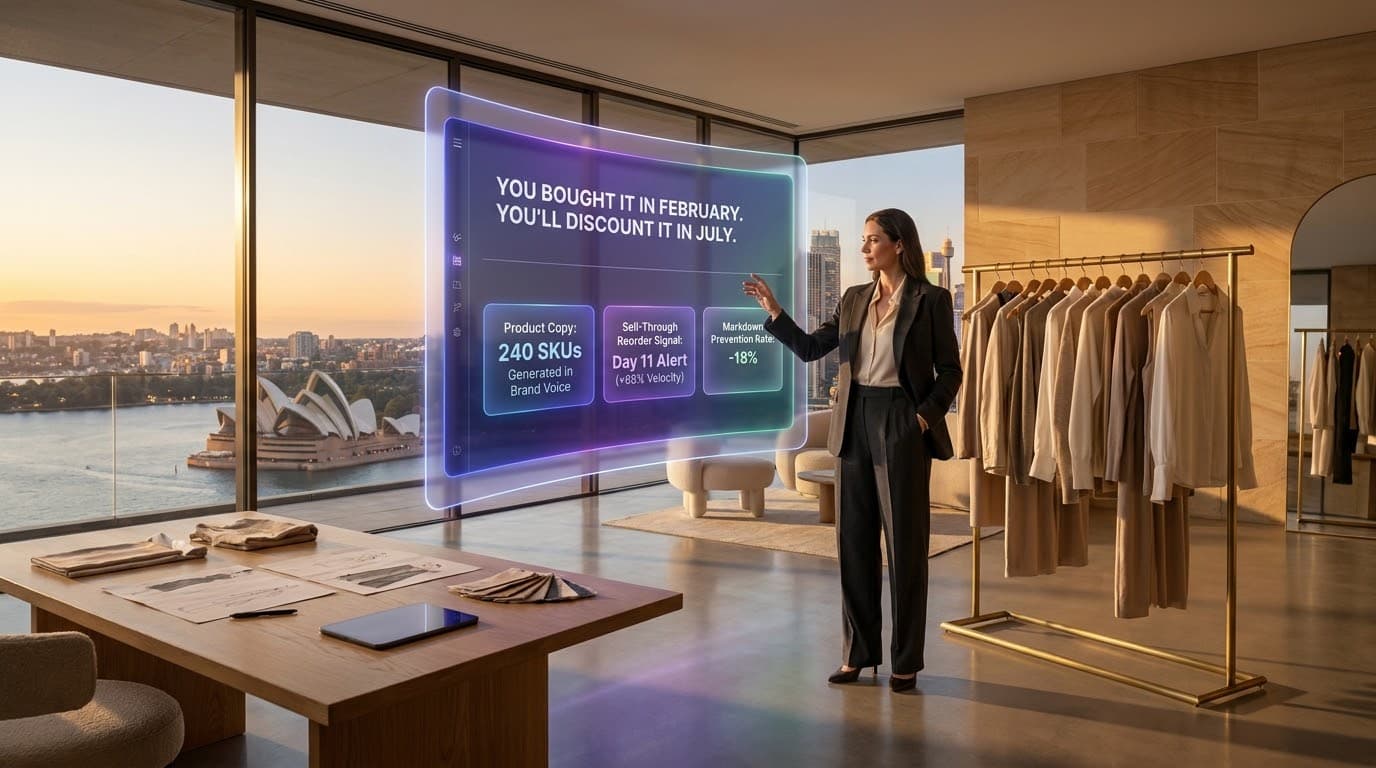
You bought it in February. You'll discount it in July.

You're writing product descriptions at 11pm because the buy lands on Tuesday and the site needs to be live by Thursday. You're reordering on instinct because nobody checked the sell-through until the warehouse called. The data already knows what to do — it just isn't reaching you in time.

The buying instinct stays yours. The writing, replying, reporting and chasing don't have to.

Works with Shopify, Lightspeed and your existing POSYour brand voice, not generic AI copyNo email required to see your score
Product copy240 SKUs
Reorder signalDay 11
The short version

In fashion retail, the three most expensive problems are markdown from buying the wrong depth, the time it takes to get product live and described, and repeat purchase rates that sit far below what the customer list could support.

All three are information problems before they are taste problems. The reorder signal exists in your sell-through data by day 10 — it just isn't reaching you. The product descriptions are a writing task, not a creative one. And the customer who bought twice is being emailed the same campaign as someone who bought once, two years ago.

Where the money goes

Three problems, and they're the same three every time.

We've run the assessment across boutiques, labels and multi-channel brands. The order of the findings barely changes.

Pain 01

The reorder window closes before you notice it opened.

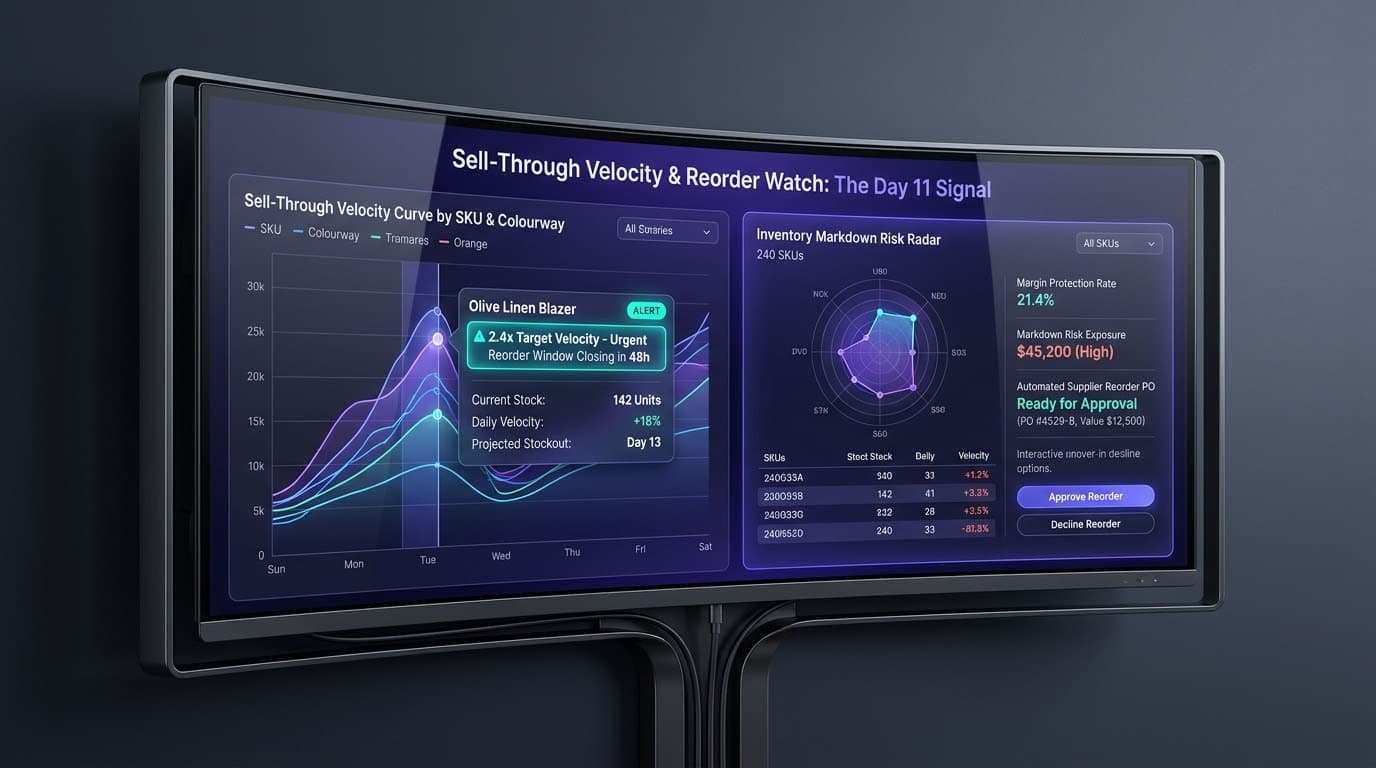
Sell-through velocity is visible in your data by day 10 of a new arrival. If a colourway is running at twice the rate of the others, the reorder conversation needs to happen that week — not after you've done the month-end stocktake and found the gap. Most buying decisions happen on feel and memory rather than on the numbers that are already there.

What it costsMarkdown is the cost of buying the wrong depth. The signal that would have corrected it was in the system all along — it just wasn't surfaced in time.

What we put in place

  • Sell-through velocity by SKU, colourway and size from day one
  • Reorder flags when a line is tracking above threshold — before the window closes
  • Buying review with the data shaped for a decision, not a spreadsheet
Merch AnalystReorder Watch
Pain 02

240 new SKUs, and the descriptions are your Sunday.

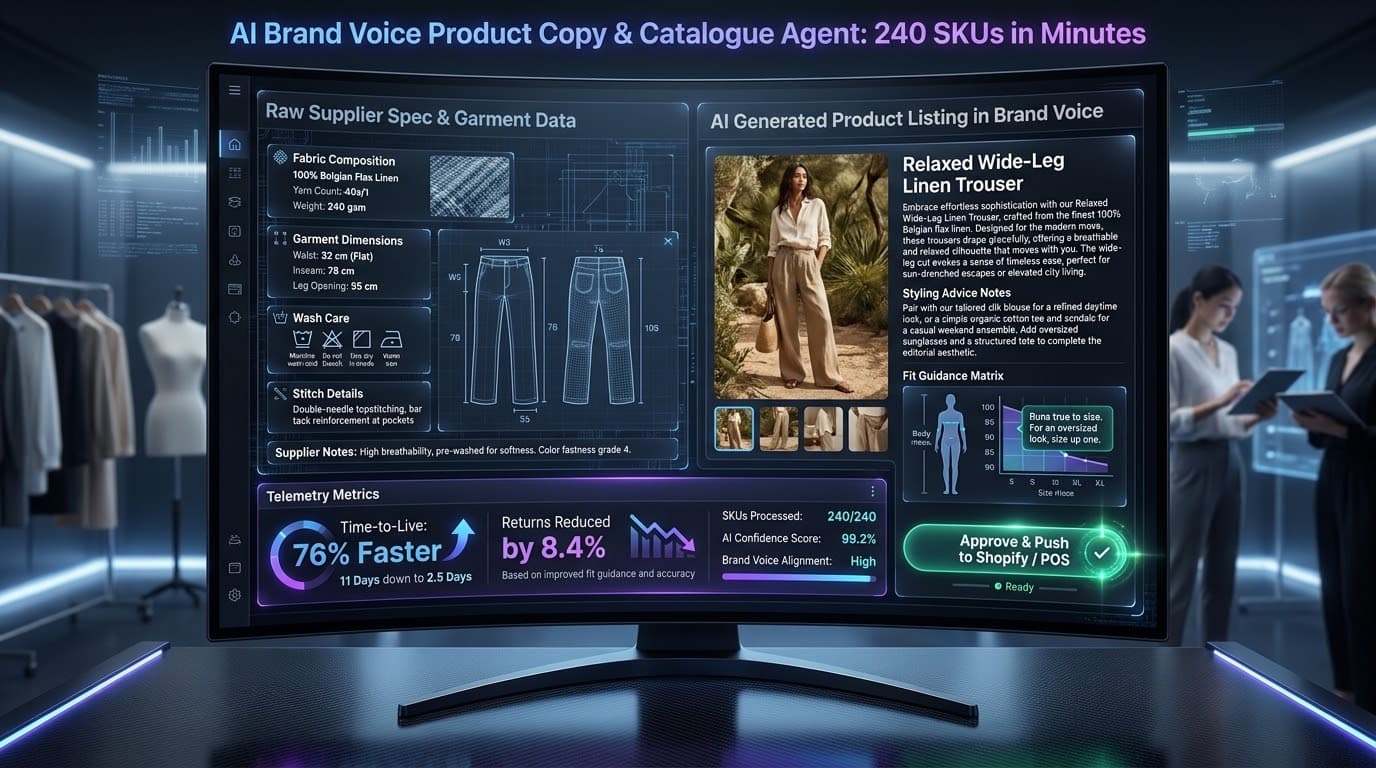
A new season buy means hundreds of listings to write — fabric, fit, care, styling — in a voice that sounds like your brand, not a manufacturer's spec sheet. Consultants and founders end up doing this themselves because nobody else knows how the brand talks. It takes days. Every day the product isn't live is a day it isn't selling.

What it costsTime to live is margin. If a product takes two weeks to get a proper listing, those are two weeks of full-price selling window that don't come back.

What we put in place

  • Product copy written in your brand voice, trained on your own best descriptions
  • Fabric, fit and care fields populated from your own supplier data
  • Review and approve workflow — nothing goes live without your sign-off
Product Copy AgentCatalogue Agent
Pain 03

She bought three times. She gets the same email as everyone else.

Your customer list contains people who are genuinely loyal, people who bought once on sale, and people who haven't opened an email in eighteen months. They're all getting the same campaign. The repeat buyer deserves an early-access drop. The one-time sale buyer needs a reason, not a discount. The lapsed customer needs something different again.

What it costsRepeat purchase rate in fashion retail typically sits 15–20 points below what the existing list could support if it were properly segmented and sequenced.

What we put in place

  • Segmentation by purchase count, recency, average order value and category
  • Lifecycle flows that send the right thing to the right segment at the right time
  • Lapsed customer reactivation that doesn't start with a discount
CRM AgentLifecycle Agent
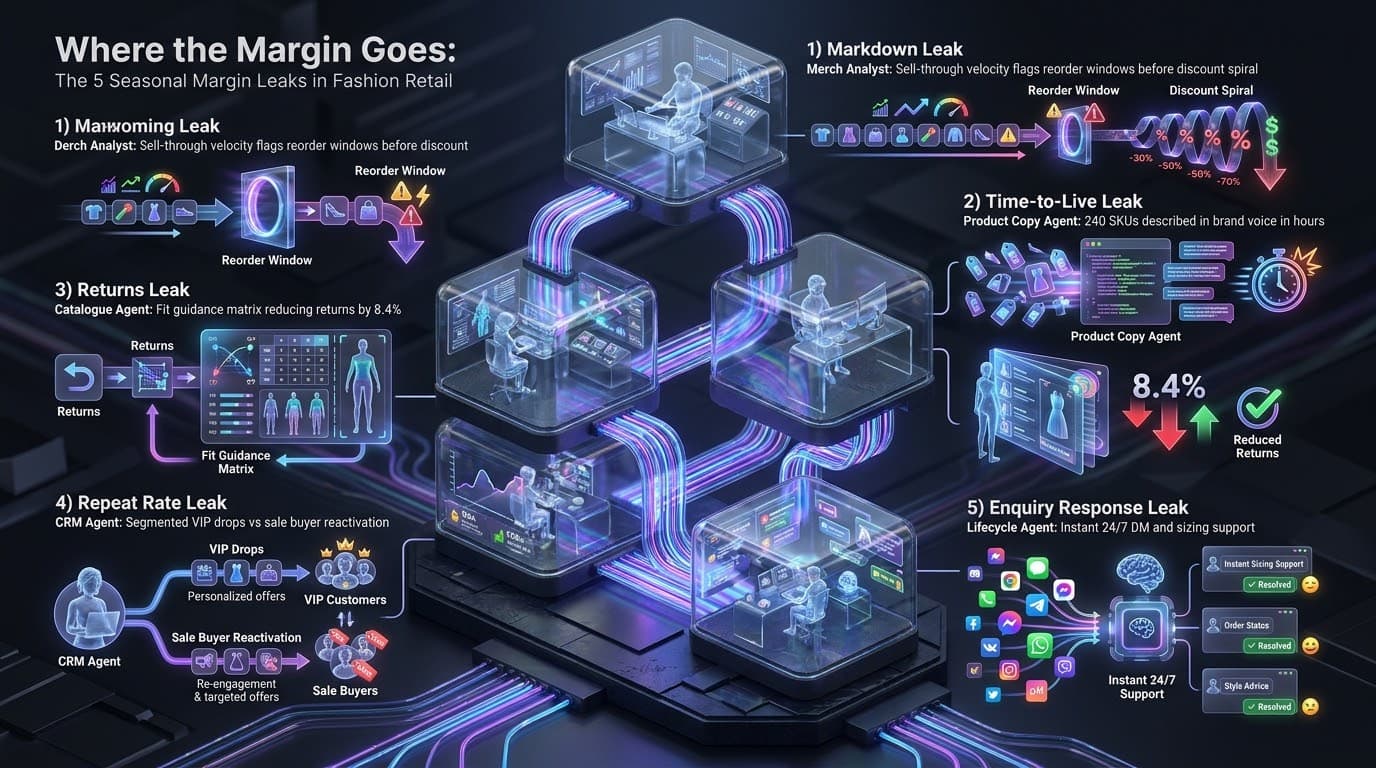
The shape of the leak

Every season has the same five places the margin goes.

None of these are taste problems. They're information and timing problems — and every one of them has a signal that arrives before the cost does.

LeakCostAgent
MarkdownBuying the wrong depth on the wrong lines15–25% of seasonal marginMerch AnalystSell-through velocity flags reorder windows before the discount decision
Time to liveProduct not listed until weeks after landing1–2 weeks of full-price window lost per SKUProduct Copy AgentDescriptions generated in brand voice, reviewed and approved before publishing
ReturnsFit uncertainty driving try-and-return behaviour8–14% of revenue eroded by returns processingCatalogue AgentFit guidance at the point of decision, drawn from your own sizing data
Repeat rateLoyal customers getting the same email as everyone else15–20 pts below what the list could supportCRM AgentSegmentation by purchase count, recency and category drives differentiated flows
Enquiry responseDMs and emails answered the next day or not at allConversion lost to competitors who replied firstLifecycle AgentFirst response on arrival, qualified and routed before the team starts the day
What it looks like when it works

Two stores, one website, and a Sunday that never ended.

Womenswear labelSydney · two stores and DTC~600 SKUs a season

Every description written by the founder on the weekend.

Before

Each new season buy landed on Tuesday and needed to be live by the weekend. The founder wrote every product description herself — fabric, fit notes, care, styling — because nobody else knew how the brand talked. Reorder decisions were made from gut feel at the month-end stocktake. The email list received the same campaign regardless of whether a customer had bought three times or once, two years ago.

Assessment found

Around 7.5 hours per week going into product copy that repeated the same structure with different fabrics. Reorder windows on fast-moving colourways closing before anyone noticed — the signal was in the data by day 11, but nobody was reading it. Customer segmentation existed as an intention but had never been implemented. Three distinct customer profiles in the list, all receiving identical content.

What we built

A Product Copy Agent trained on the founder's 40 strongest existing descriptions — it writes in her voice, not in generic AI copy. A Reorder Watch that reads sell-through velocity by day 11 and surfaces a flag when a line is running above threshold. A CRM segmentation and lifecycle flow that sends early access to the top tier and reactivation sequences to lapsed buyers. Everything reviewed before it goes out.

Time saved
7.5 hrsPer week — founder's writing time returned as buying and relationship time
Time to live
76% fasterStock-to-live on new arrivals — from 11 days to under 3
Returns
−8.4 ptsReturns rate reduction after fit guidance deployed at point of decision

Percentages are measured against the baseline captured in the assessment. Product copy is reviewed and approved before anything goes live. Returns reduction is attributed to fit guidance, not to changes in product or fulfilment.

Measure your own baseline
Where to start

Four ways in, depending on which problem is yours.

You don't need all of it, and we'll say so. If the free assessment shows there's nothing worth building yet, that's the recommendation you'll get.

Start here if you're not sure

AI Tune Score

Twelve questions, six dimensions, four minutes. Tells you which of the three problems is actually costing you most, and whether you need anything built yet.

  • A score and your top three opportunities
  • No email required to see the result
  • An honest answer if the timing is wrong
FreeRead more
If markdown or reorders are the bottleneck

AI Consulting

We map how product and buying data actually moves through your business, then build the workflows that surface signals before costs land. Fixed scope, stated price, delivered by the Sydney team.

  • AI Tune-Up from AUD $2,500 in 3–5 days
  • Merch Analyst, Reorder Watch and Copy Agent
  • Package 1 fees credit against any upgrade within 90 days
From AUD $2,500Read more
If product copy and listings are the bottleneck

Marketing Automation

Product descriptions in your voice, lifecycle flows that segment properly, and enquiry coverage that doesn't require you to be online on a Sunday.

  • Copy agent trained on your own catalogue
  • CRM segmentation and lifecycle flows
  • Works with your existing Shopify or Lightspeed setup
From AUD $399/moRead more
If repeat rate and acquisition are the problem

Digital Marketing

A search and content programme that builds demand before sale season, and paid channels that reach the right buyer at the right point in the consideration window.

  • Category and brand topical authority
  • Lifecycle and reactivation email programmes
  • Paid social and search aligned to your buy calendar
From AUD $99/mo per moduleRead more
Drop calendar and pipeline

Ad spend is only as good as what happens in the next seven days.

Most fashion retailers don't have a paid media problem. They have a listings delay, a reorder gap, and a repeat-rate problem that paid media makes more expensive — every extra dollar buys more traffic into the same leak.

Google Ads

The feed is the campaign

Someone searching "wide-leg linen pants Sydney" has already decided they want the product. Google Shopping puts the right image and price in front of them at exactly that moment. Wasted spend in fashion hides in broad-match keywords that bleed into research queries and competitor browsing — not in the channel itself.

  • Shopping campaigns split by category and season
  • Negative lists built from your own search-term data
  • Bid pressure moved to new arrivals and hero SKUs
Meta Ads

Where the discovery still happens

Nobody buys a $380 dress from one Instagram ad. Meta earns its place at the top of the funnel — building product desire before someone knows they want it, then retargeting the people who viewed but didn't buy. The creative is your product; the job is putting it in front of the right person at the right moment in the season.

  • Prospecting campaigns timed to new-season arrivals
  • Retargeting on product views and abandoned carts
  • Lookalikes from past full-price buyers, not one-time sale customers

The pipeline a drop runs into

Six stages, each one measured. If you can't name the cost per repeat buyer by category, the budget is being set on feel.

  1. 01BuyProduct lands, sell-through baseline set from day one
  2. 02LandListings live in under three days, descriptions in brand voice
  3. 03ListGoogle Shopping and Meta campaigns go live with the drop
  4. 04LaunchEarly-access email to top-tier customers before public release
  5. 05Day 11Reorder flag if sell-through is running above threshold
  6. 06RepeatPost-purchase flow timed to replenishment window by category

Attribution in fashion is complicated by multi-session consideration, cross-device research and the influence of physical stores on online returns. We report cost per full-price sale by category with the assumptions stated, rather than a blended number that flatters the channel.

Brand and merchandising

Everyone sells the same fabrics.

Speed wins the algorithm. Brand is what makes the customer choose you before she's compared anything — and what makes her come back without a discount.

  • Discounting is a positioning decision, not a pricing one.Every sale trains your customer to wait. The brands that avoid the discount spiral have a stated reason to buy at full price — and that reason is communicated before the product launches, not after it hasn't sold.
  • Product copy is brand copy.The way you describe a fabric, a fit or a care instruction is the voice your customer hears when she's deciding. Generic descriptions lose the sale to whoever sounds more like a brand. Yours should sound like yours.
  • The unboxing is the review.In fashion the physical object is the retention tool. A well-made tissue, a card with the right message, and a return experience that doesn't feel punitive are the cheapest repeat-purchase drivers in the business.
Packaging suiteTissue, box, ribbon and card — the first physical brand experience after the click
Swing tags and care labelsEvery tag is a touchpoint. Most brands treat them as a compliance document.
In-store and retail collateralSignage, lookbooks and displays that make the buying decision before the staff conversation starts
What the AI doesn't touch

The buying instinct stays yours.

AI handles the writing, the reporting, the flagging and the chasing. The decisions, the relationships and the taste stay with your team.

The buy

The product selection, the supplier relationships, the instinct for what will sell. That's the job — and it stays entirely with you.

The aesthetic

Visual direction, brand tone, creative decisions. The agent writes in your voice because it learns from your work. The aesthetic is yours.

Anything a customer reads

Every description, email and reply goes through your review before it reaches a customer. Nothing is published or sent without your approval.

Supplier relationships

Negotiations, exclusives, sampling, trust built over seasons. No workflow touches any of that.

Questions

What retailers ask us first.

The highest-value uses are product copy at scale, sell-through velocity signals that catch reorder windows before they close, customer segmentation that separates genuine repeat buyers from one-time shoppers, and first-response coverage for enquiries that arrive when the store is closed. The buying instinct stays yours — the writing, reporting and chasing don't have to.

Start with the measurement

Before the next buy, find out what the last one cost you.

Four minutes, twelve questions, one honest answer about where the margin went in your last season — and whether it's worth building anything before the next one lands.

Free · No email required to see your result · Sydney, Australia