

The short answer
The right first AI employee is the one with the highest cost of delay: hours saved per week multiplied by loaded hourly rate, times 52 weeks, minus tool cost. For most Australian SMBs between 5 and 50 staff, that ranking puts Marketing automation, Client onboarding, or Financial reporting at the top. People/HR and R&D almost always score lowest and should be deliberately postponed.
What you'll take away
- Why 87 specialists is a menu, not an answer, and what to ask instead
- The cost-of-delay formula that replaces gut feel with a defensible number
- Honest scoring for all six business functions in an SMB context
- The three functions that compound fastest, with a Sydney worked example
- The two functions worth deliberately postponing and why
- A four-question worksheet you can complete in ten minutes
Eighty-seven specialists is a menu, not an answer
Open any AI marketplace and you will find hundreds of specialists on offer. Sales development, content generation, meeting summarisation, invoice reconciliation, hiring shortlists, procurement analysis, competitor tracking. Every one of them will make a compelling case for itself. Every one of them will also demand time, attention, and a monthly subscription.
A menu with 87 items does not answer the question you actually have, which is: what should we do first? The wrong first hire does not just waste the subscription fee. It burns three months of goodwill in the team, produces a case study that quietly discourages the next round of investment, and leaves the process it was meant to fix in exactly the state it was in before.
The sequencing question matters more than the tool question. A mid-tier tool applied to your highest-cost-of-delay function will produce a better result than a best-in-class tool applied to a function that was not really hurting you. Sequence first, then choose the tool.
The cost of delay
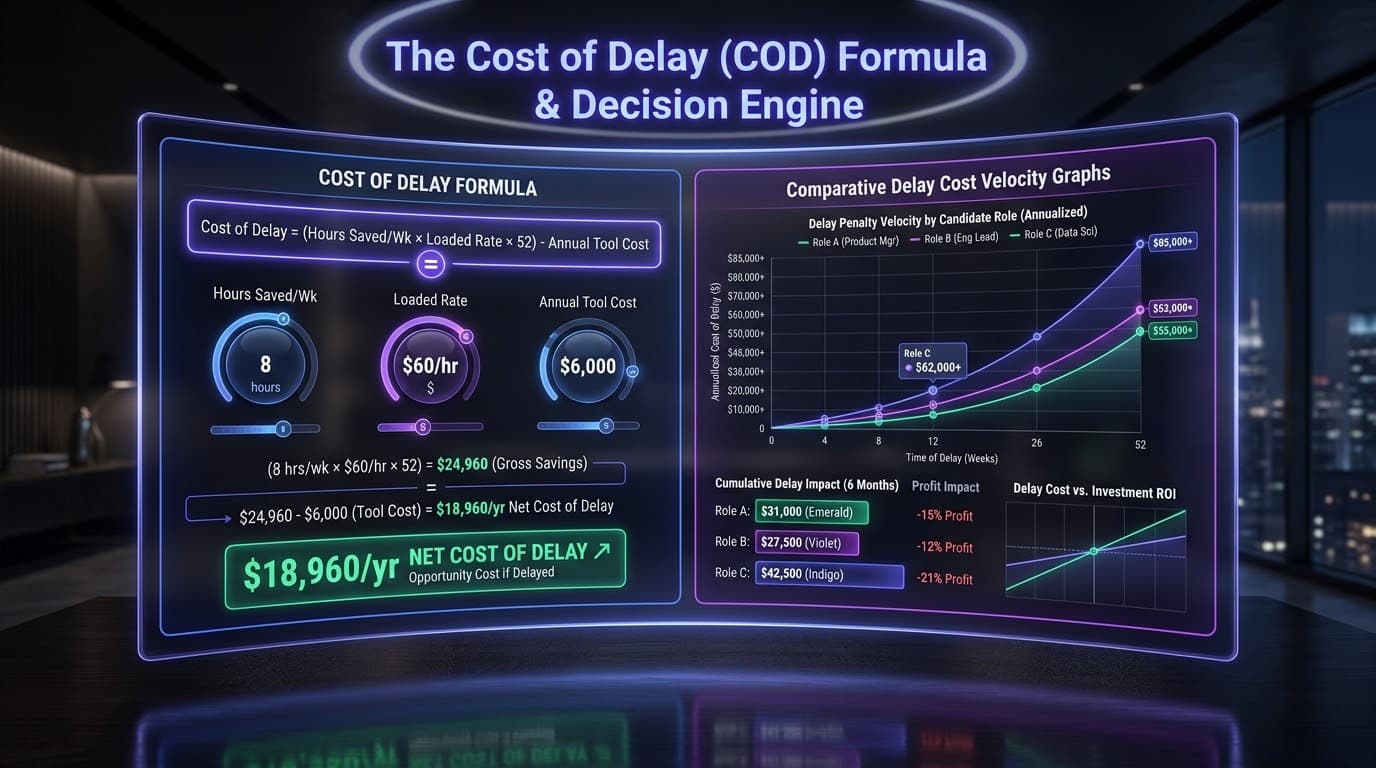
Cost of delay is a single number that answers a simple question: how much money is this process costing us every week we leave it as it is? The formula is straightforward.
Cost of delay (annualised) = (hours saved per week × loaded hourly rate × 52) − annual tool cost.
Loaded hourly rate is the person's salary plus super, plus payroll tax, plus their share of overhead, divided by working hours. For most Australian SMB roles, this lands 30 to 50 per cent higher than the base hourly wage. A $75,000 marketing coordinator has a loaded rate near $55 to $60 an hour, not $37.
A worked example. If a marketing automation saves 8 hours a week for a coordinator at a loaded rate of $60, the annual value is 8 × 60 × 52 = $24,960. Subtract $6,000 in annual tool fees and the cost of delay is $18,960 per year. That is what you are paying, in real dollars, every year you wait to make that hire.
Now score your candidate functions against each other using the same formula. The one with the highest cost of delay wins the queue. This is how you choose, not gut feel, not novelty, not whichever vendor sent the best-produced demo video last week.
Talk it through 15 minutes.
Book 15 minutes with the Bizkook team and we will run the sequencing exercise with you — so you pick the right first function before you spend anything.
Ranking the six functions
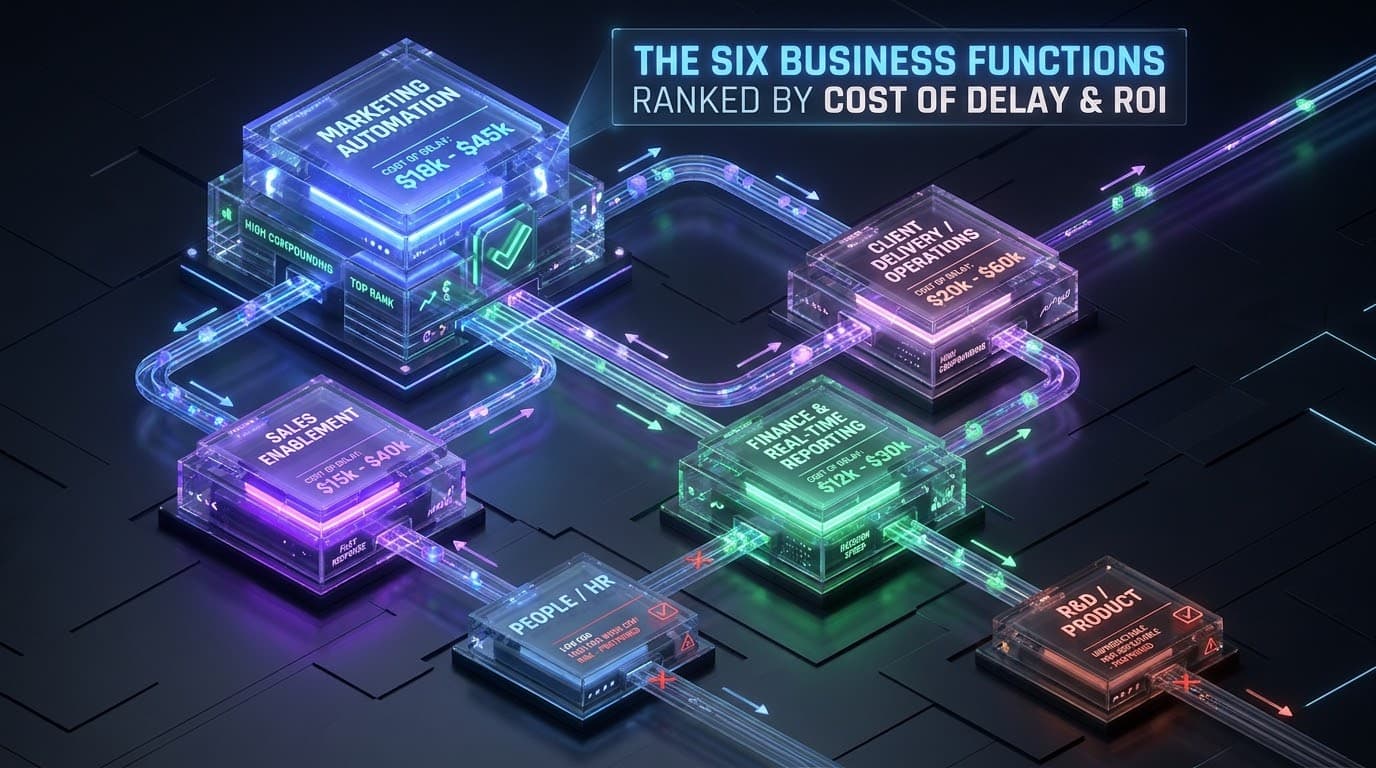
Every SMB touches six broad functions: Marketing, Sales, Client Delivery/Operations, Finance, People/HR, and R&D. Here is how each typically ranks for a 5 to 50 staff Australian business, with typical cost of delay, compounding value, and setup complexity honestly assessed.
| Function | Typical COD (annual) | Compounds? | Setup complexity |
|---|---|---|---|
| Marketing | $18k – $45k | Yes, high | Low to medium |
| Sales | $15k – $40k | Yes, high | Medium |
| Client Delivery / Operations | $20k – $60k | Yes, high | Medium |
| Finance | $12k – $30k | Yes, medium | Low |
| People / HR | $4k – $10k | No, low | High (compliance) |
| R&D / Product | Variable, unclear | No, custom | High (bespoke) |
Marketing consistently ranks high because every lead captured today feeds the sales pipeline next month, and the process is highly repeatable. Sales ranks close behind because response speed and follow-up cadence are two of the biggest predictors of conversion in the SMB market. Client Delivery scores well when the business is fully booked, because a bottleneck in delivery is limiting revenue directly.
Finance ranks solidly and is often underrated. It does not feel exciting, but automated reporting feeds every other decision in the business. If your P&L is a week old, every strategic call you make is a week late.
People/HR and R&D consistently rank low for SMBs. Both are covered in the postponement section below.
The three that compound fastest
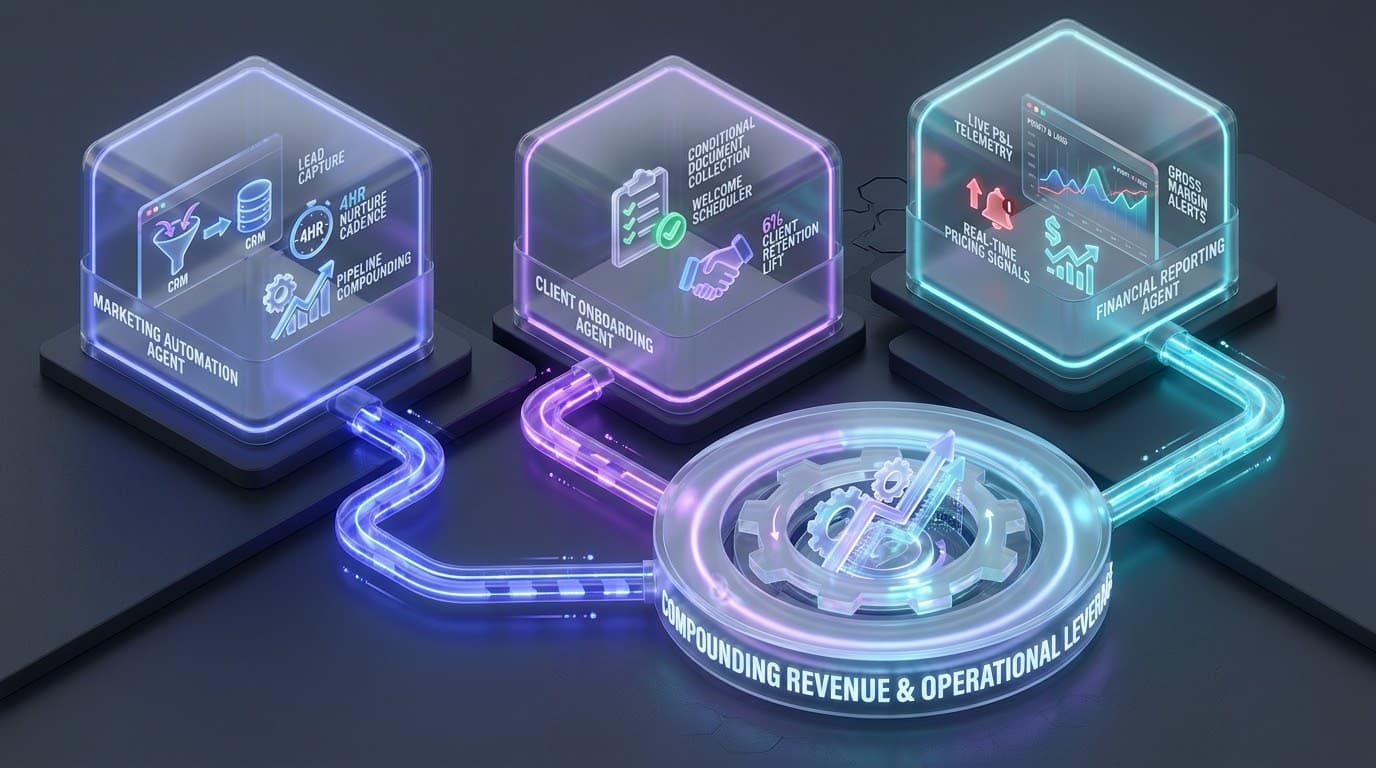
Three functions produce compounding returns rather than one-off gains, and this is what makes them ideal first hires. Take a Sydney professional services firm we worked with as the reference case: 10 staff, $2.5m annual revenue, growing steadily but constrained by owner-operator time.
Marketing automation
Every lead captured feeds Sales. Every insight the marketing tool learns about which sources convert best sharpens the next campaign. Twelve months into a well-configured marketing automation, this firm was capturing 40 per cent more inbound inquiries with the same ad spend, because their lead follow-up cadence went from four days to four hours and their nurture sequences ran continuously instead of when someone remembered.
Cost of delay in year one was calculated at $28,000. In year two, because the pipeline had grown, the same automation was displacing roughly $46,000 in coordinator hours it would have taken to keep pace. That is the compounding effect: the value grows with the business.
Client onboarding
Onboarding sets up recurring revenue. A client whose first two weeks are smooth, professional, and clear is materially more likely to renew, refer, and expand scope. Manual onboarding forgets steps, delays document collection, and starts the relationship with the client feeling like they are dragging you.
The Sydney firm automated their onboarding sequence with conditional document collection, a welcome scheduler, and an automated kickoff brief generated from the intake form. Client satisfaction at 30 days improved measurably. Renewal rate the following year lifted by six percentage points. Applied to $2.5m in revenue with 60 per cent recurring, that is roughly $90,000 in retained revenue every year the automation runs.
Financial reporting
Reporting feeds every other decision. When the P&L is real-time, pricing calls, hiring calls, and campaign calls all get made on current data instead of a lagging snapshot. The firm connected their accounting system to a reporting layer that produced a weekly dashboard: revenue by service line, gross margin by client, cash runway, and pipeline coverage.
The direct time saving was 6 hours a week for the bookkeeper. The indirect saving was harder to quantify but larger: two pricing decisions in year one that would have gone the wrong way with lagging data. The finance automation cost $4,800 for the year. Cost of delay was calculated at $19,000 excluding the pricing effect.
The wrong sequence costs you twice, once in money and once in momentum.
Two worth deliberately postponing
People and HR
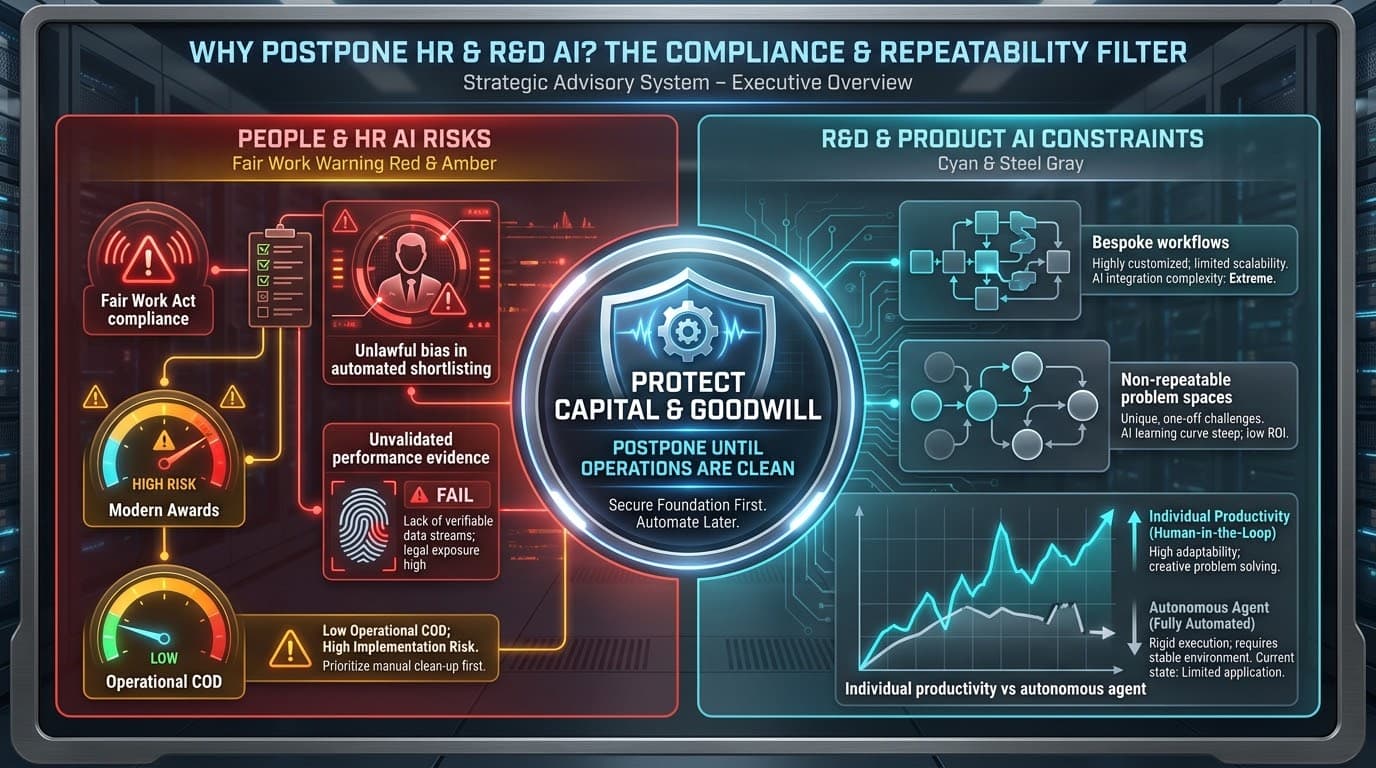
Australian employment law is dense. The Fair Work Act, modern awards, National Employment Standards, and record-keeping obligations create compliance exposure that a generic AI tool can worsen rather than improve. AI-generated position descriptions can drift into unlawful territory. Automated shortlisting can encode bias in a way that becomes a discrimination complaint. Automated performance summaries that end up in a dispute create real evidence problems.
The functional COD is also low for most SMBs. Hiring happens intermittently, performance reviews are quarterly at best, and the hours saved are modest compared to compliance risk. For businesses under 50 staff, postpone HR AI until you have a compliance-reviewed tool, a documented policy, and a specific process with legal sign-off.
R&D and product
R&D fails the repeatability test. Every research task is unique by definition, every product decision depends on context that changes weekly, and there is no clear five-step procedure. AI tools help individual researchers and product managers with specific tasks like summarisation or analysis, but that is a personal productivity story, not an AI employee story. Wait until the rest of the business is running clean and specific R&D workflows have emerged that are worth automating.
The one-page worksheet
Take each of your six functions and score them 1 to 5 on the four questions below. Highest total is where you start.
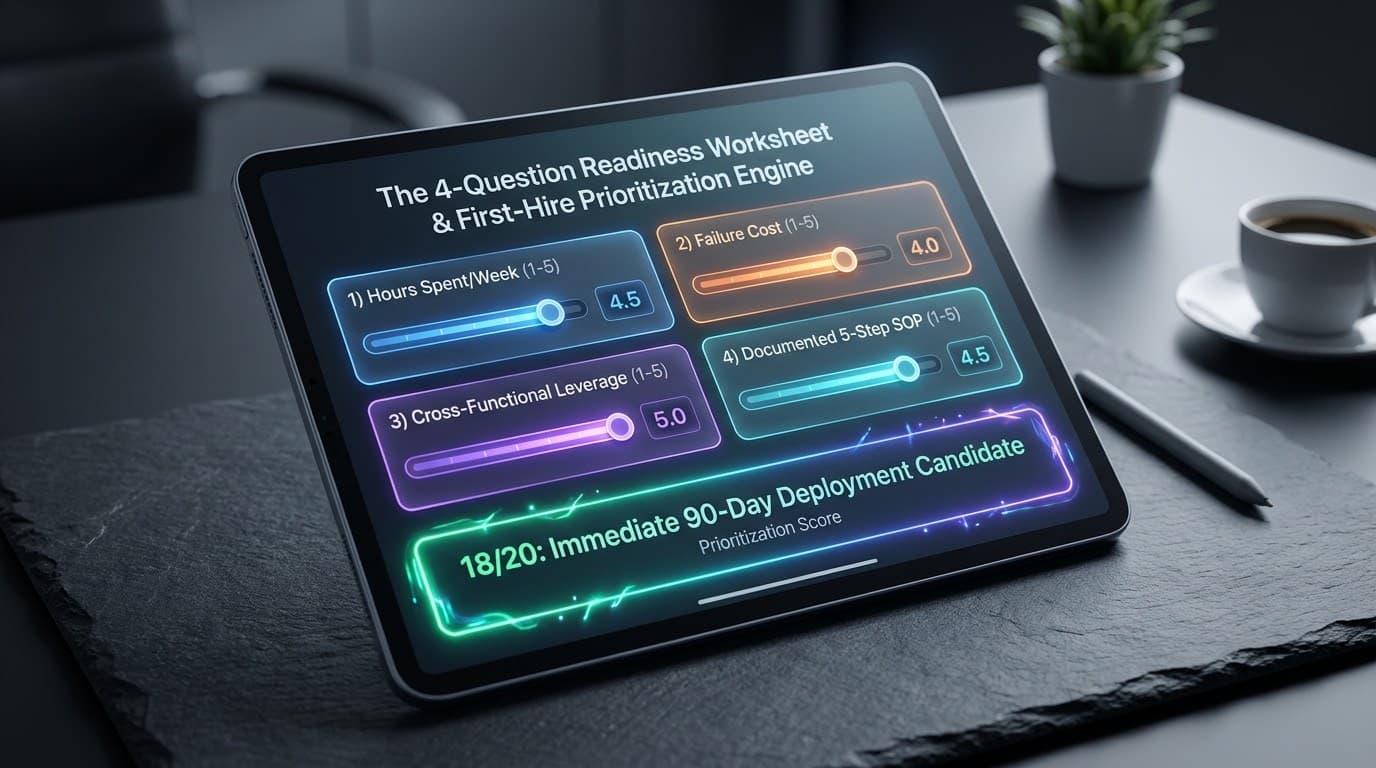
- Hours per week the team spends here. 1 = under 5 hours, 5 = over 40 hours across the whole team.
- Cost when it goes wrong. 1 = mild inconvenience, 5 = lost clients, compliance exposure, or missed revenue.
- Does improving it make other functions easier? 1 = self-contained, 5 = it unblocks two or more other functions.
- Could you write a clear 5-step procedure for it? 1 = every case is different, 5 = the steps are already in a document.
A total of 16 or higher is a strong first hire. Between 12 and 15 is a viable second or third. Under 12 either needs process work first or should be postponed. Do this in ten minutes, not two hours. First-pass scoring is usually right, and analysis paralysis is a bigger risk than imprecision.
What to do next
Score your six functions using the worksheet above. Calculate cost of delay for your top two candidates using the formula. Pick the winner and commit to that single function for the next 90 days. Do not spread the effort across three functions to hedge, because you will halve the learning from each and double the coordination overhead.
Once you have your candidate, read which business process to automate first for the sub-scoring inside that function, and the unit economics of an AI employee for the payback math that will keep the finance side of the decision defensible.
Our AI consulting engagements begin with exactly this sequencing exercise. It is the cheapest and most valuable hour we spend with any client, and it prevents the most common failure mode in SMB AI adoption: hiring the wrong first employee. Prefer to talk first? Book 15 minutes with the Bizkook team at bizkook.com/book.
Prefer to self-check in 4 minutes?
The AI Tune Score maps your business across six dimensions and scores each function for readiness — so you know which to start with before any conversation.
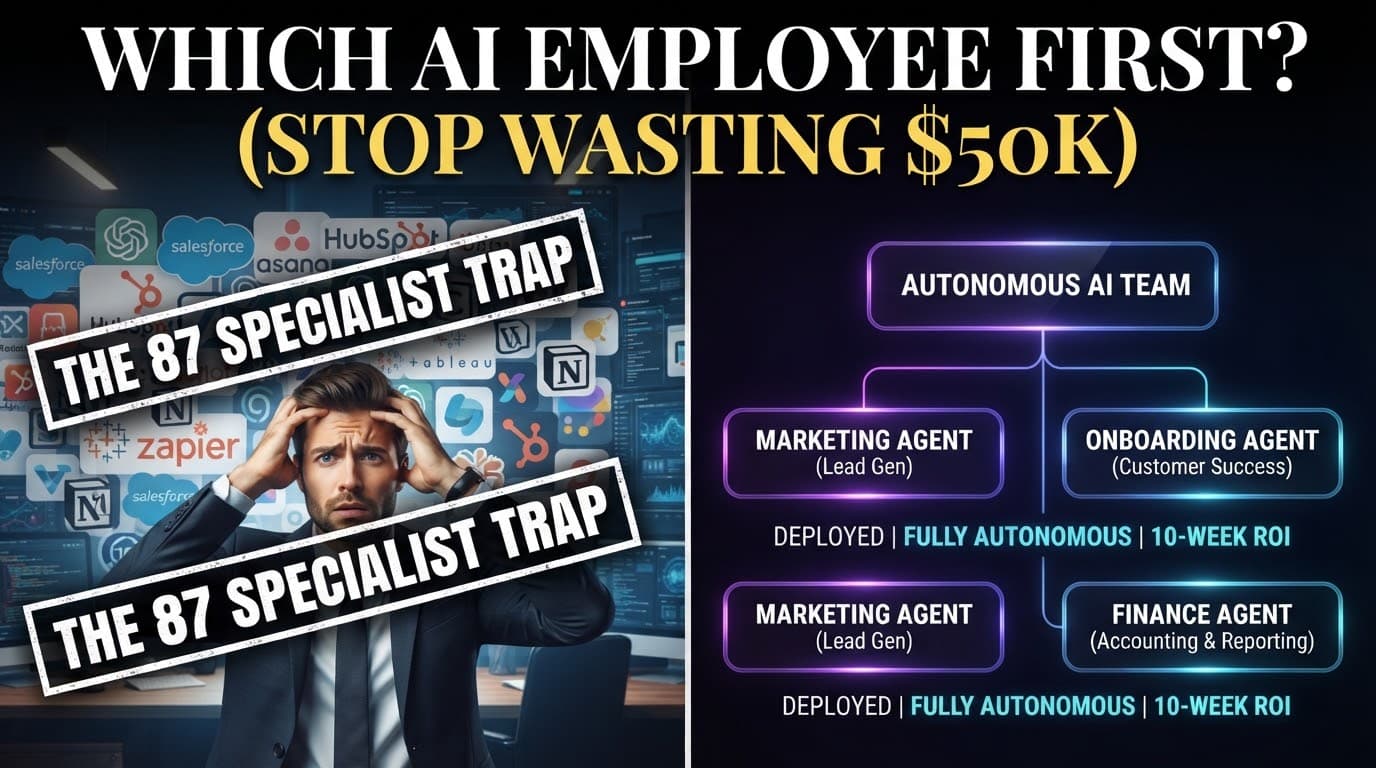
Watch: which AI employee first, in six minutes
The Bizkook team walks through the sequencing problem, the cost-of-delay formula, the six-function ranking, the three that compound fastest, the two worth postponing, and the one-page worksheet.
 5:45
5:45Chapters
- 0:00Why 87 specialists is a menu, not an answer
- 0:50The cost-of-delay formula, worked
- 1:45Ranking the six business functions
- 2:45The three that compound fastest
- 3:50Two functions worth deliberately postponing
- 4:40The one-page four-question worksheet
- 5:15What to do next
In summary
Deciding which AI employee to hire first is a sequencing problem, not a menu problem. Score each function against the cost-of-delay formula, pick the one with the highest number, and commit to it for 90 days. For most Australian SMBs, that ranking puts Marketing, Client Onboarding, or Financial Reporting at the top — and postpones HR and R&D.
Get your AI Tune ScoreCommon questions
Answered directly, so they can be quoted without the surrounding argument.
Readiness is less about technology and more about repeatability. If you can describe at least one process in five clear steps, you have documented data going in and out, and the same result is expected each time, you are ready. If every job in your business is bespoke and nothing is written down, standardise first. AI does not fix chaos, it amplifies whatever process you already run.
How this piece was produced
Written by the Bizkook team using direct experience from Sydney consulting engagements and cost-of-delay analysis with Australian SMBs between 5 and 50 staff. Reviewed and edited by the Bizkook team. Published August 2026.