

The short answer
Agentic AI is a class of artificial intelligence system that acts autonomously to complete multi-step goals without requiring a human prompt for every action. Unlike generative AI, which responds to a single prompt and stops, agentic AI perceives its environment, reasons through options, acts via tools and APIs (sending emails, querying databases, updating CRMs, triggering workflows), and learns from outcomes. This four-step loop (Perceive, Reason, Act, Learn) can run continuously, making agentic AI the first AI category capable of operating as a digital worker rather than a digital assistant. In 2026, Australian businesses across fintech, healthcare, logistics, and e-commerce are deploying agentic AI to automate lead qualification, document processing, customer triage, and multi-step workflow orchestration.
What this guide covers
- What agentic AI is and how it differs from generative AI and traditional automation
- How the four-layer architecture works (reasoning engine, tool layer, memory, orchestration)
- Real Australian use cases with realistic worked examples
- Honest cost ranges and ROI context for AU businesses
- Governance and Privacy Act compliance requirements for 2026
What this guide does not do: promise specific revenue outcomes or guaranteed ROI, recommend a single tool as universally correct, or replace legal or compliance advice for your specific situation. This guide is for general education and business decision-making only. It does not constitute legal, privacy, or compliance advice. For specific obligations under the Privacy Act 1988 (Cth) and the Privacy and Other Legislation Amendment Act 2024, consult your legal adviser or the Office of the Australian Information Commissioner (oaic.gov.au).
Agentic AI in one paragraph: Agentic AI is a class of AI system that acts autonomously: perceiving its environment, reasoning through options, acting via tools and APIs, and learning from outcomes, in a continuous loop without a human prompt between each step. It differs from generative AI (which answers prompts) and from traditional automation (which follows fixed scripts) by combining a reasoning engine with memory, tool access, and an orchestration layer. In Australia in 2026, businesses are using it to automate lead qualification, invoice processing, customer triage, and multi-step workflow orchestration, integrated with tools like Xero, HubSpot, and Shopify.
What Is Agentic AI?
Agentic AI is a class of artificial intelligence system that acts autonomously to achieve multi-step goals without requiring a human to prompt every action. Unlike generative AI (which produces content in response to a prompt), agentic AI perceives its environment, reasons through available options, acts via tools and APIs (sending emails, querying databases, updating CRMs, triggering workflows), and learns from the outcomes of each action. This agentic AI perceive reason act learn loop can run continuously, making agentic AI the first AI category capable of operating as a digital worker rather than a digital assistant. In Australia in 2026, agentic AI is being deployed by businesses across fintech, healthcare, logistics, and e-commerce to automate lead qualification, document processing, customer triage, and multi-step workflow orchestration, often integrating with existing tools like Xero, HubSpot, and Shopify.
The word “agentic” refers to agency: the capacity to initiate and sequence actions independently. Autonomous AI decision-making is what distinguishes agentic systems from reactive tools: the agent does not wait to be asked what to do next. It has a goal, a set of tools, and the reasoning capacity to work out how to use those tools to reach that goal. For a plain-English comparison with other AI types, see our detailed explainer on what agentic AI is.
Large language models (LLMs) such as Anthropic Claude, OpenAI GPT-4 and GPT-5, and Google Gemini serve as the reasoning engine inside agentic AI systems. The LLM alone does not make a system agentic. What makes a system agentic is the addition of the agentic AI memory layer explained above, plus tools and an orchestration loop around that reasoning engine. Tracking agentic AI 2026 trends Australia, the clearest pattern is that businesses deploy the memory and tool layers before adding orchestration complexity. For more on how Claude powers agentic systems in practice, see what Claude AI is and how it works.
How agentic AI perceives its environment
Agentic AI perceives its environment by reading from connected data sources: email inboxes, CRM records, databases, APIs, documents, and web pages. Each input is processed by the LLM reasoning engine to build a current picture of what is happening and what context is relevant to the task. Perception is the step where the agent gathers the raw material it needs before deciding what to do. In a lead qualification workflow, perception means reading an incoming enquiry email, looking up the sender in the CRM, and pulling any prior interaction history.
How it reasons through options
Agentic AI reasons by asking the LLM to evaluate the current state, compare available actions, and decide on the next step given the goal. This reasoning happens inside the model: the agent is not following a fixed script but working out what to do based on the current context. The quality of the reasoning depends on the quality of the foundation model and the quality of the instructions (the system prompt) given to the agent. For a business, this is the step where the agent decides whether an inbound enquiry is high-priority, which team member to route it to, and what the draft response should say.
How it acts via tools and APIs
Agentic AI acts by calling tools: sending emails via Gmail or Outlook, updating contact records in HubSpot or Salesforce, posting entries to Xero or MYOB, writing to Google Drive, sending Slack messages, or triggering downstream automations via RESTful APIs or gRPC calls. Each tool call is an action with real-world consequences: a record changes, a message is sent, a workflow fires. This is what distinguishes agentic AI from a chatbot that only produces text. The agent is doing things, not just saying things.
How it learns from outcomes
Agentic AI learns from outcomes by updating its memory with the results of each action. Short-term memory lives in the context window of the current session. Long-term memory is stored in vector databases (tools like Pinecone, Weaviate, or pgvector) that the agent can query in future sessions. This means an agentic AI system running a recurring task (weekly lead triage, say) can remember patterns from prior runs: which leads converted, which routing decisions were overridden by humans, and which response templates worked. The learning loop is what allows agentic AI systems to improve over time rather than repeat the same errors indefinitely.
Agentic AI vs Generative AI: What Is the Difference?
The most common confusion we see from Australian business owners is treating agentic AI and generative AI as the same thing. The phrase “agentic AI vs generative AI Australia” is now one of the most common search queries we receive. They are not the same. Generative AI is a component inside agentic AI: the reasoning engine. Agentic AI is the full system built around that engine. The distinction matters because it changes how you think about governance, risk, and what a deployment actually involves.
For a full side-by-side analysis, see the full comparison of agentic vs generative AI. For cases where AI is not the right answer for your situation, see when AI is not the right answer for your business.
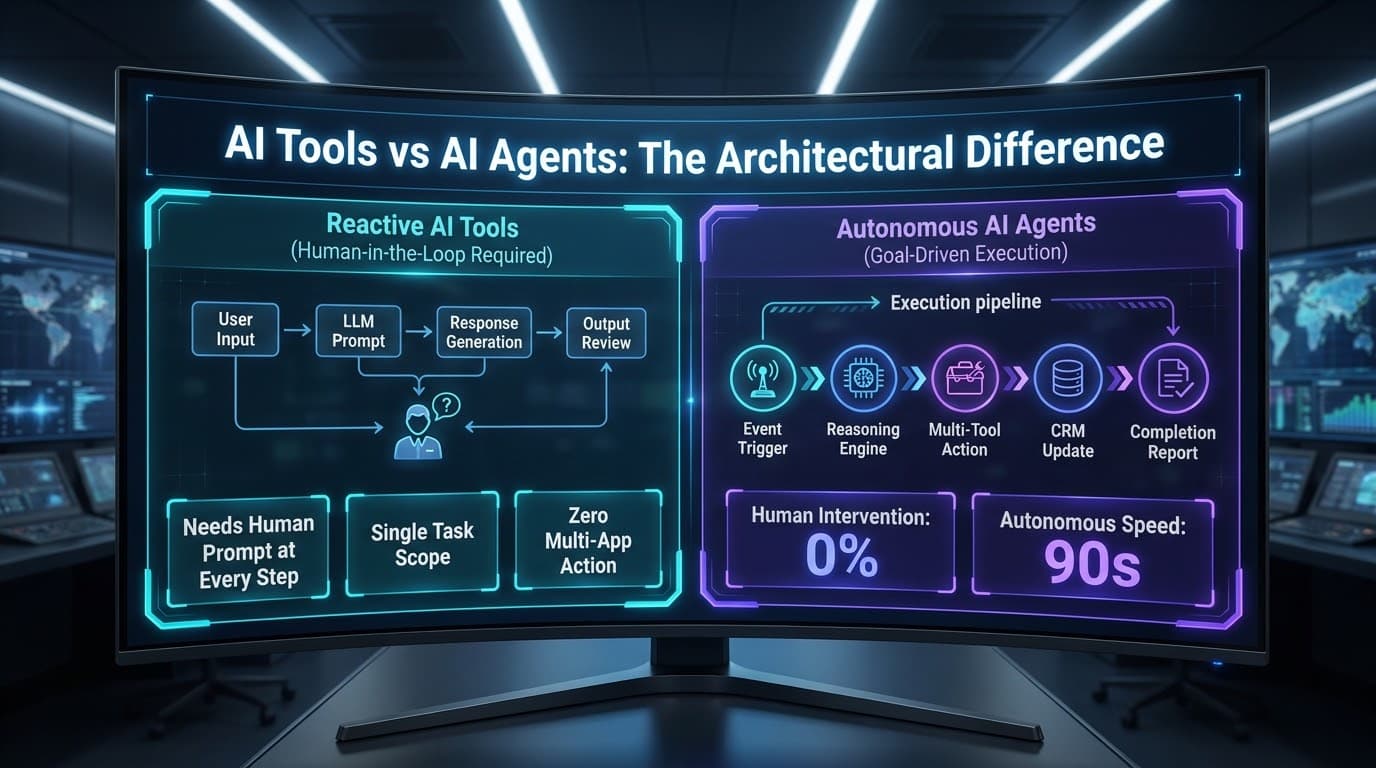
Generative AI produces output. Agentic AI executes tasks.
Generative AI responds to a prompt with content: a paragraph, a code snippet, a summary. You ask it something; it answers; the interaction ends. The key difference is generative AI limitations: autonomy is absent. It stops after each output and waits. Agentic AI has a goal and pursues it across multiple steps, calling tools and making decisions along the way. If you ask a generative AI to “qualify this lead,” it writes a paragraph about the lead. If you give the same instruction to an agentic AI system, it looks up the lead in your CRM, checks their website, scores them against your ideal client profile, drafts a personalised reply, and routes the enquiry to the right team member, all without further prompting.
Where chatbots fit on the spectrum
A chatbot is a narrow application of generative AI: it takes a message in and produces a message back. Most business chatbots have no access to real systems and no capacity to take action beyond the conversation. They sit at one end of the spectrum: input-output, single turn, no memory, no tools. Agentic AI sits at the other end: multi-step, persistent memory, tool-calling, consequential action. There is a spectrum of capability between these two points, but for most Australian businesses evaluating their options in 2026, the practical question is: does this system just answer questions, or does it actually do things?
Why the distinction matters for Australian businesses
For governance purposes, the distinction is significant. The difference between an AI chatbot and agentic AI is not just technical: it is legal. A generative AI system that writes a draft for a human to send has limited compliance exposure. An agentic AI system that sends emails, updates financial records, or makes routing decisions without human approval is a different risk profile entirely. The agentic AI vs RPA robotic process automation difference is also worth understanding: RPA follows fixed scripts and breaks on rule changes, while agentic AI reasons through novel situations. The Privacy and Other Legislation Amendment Act 2024 (Cth) introduced automated decision-making transparency requirements specifically because autonomous AI action creates obligations that a simple chatbot does not. Understanding the distinction is the first step to designing the right governance model.
| Generative AI | Agentic AI | Traditional Automation (RPA) | |
|---|---|---|---|
| What it does | Produces content from a prompt | Executes multi-step tasks autonomously | Follows fixed scripted rules |
| Needs human input | Once per output | At defined checkpoints only | At setup and exception handling |
| Adapts to new situations | Within its training | Via reasoning and tool use | No, breaks on rule changes |
| Works across systems | Limited | Yes, via APIs and integrations | Limited, fixed connectors |
| Best for | Content, summarisation, drafting | Workflow automation, multi-step tasks | High-volume rule-based data entry |
| Risk level | Hallucination, bias | Hallucination plus consequential action errors | Brittle on system changes |
| Myth | Fact |
|---|---|
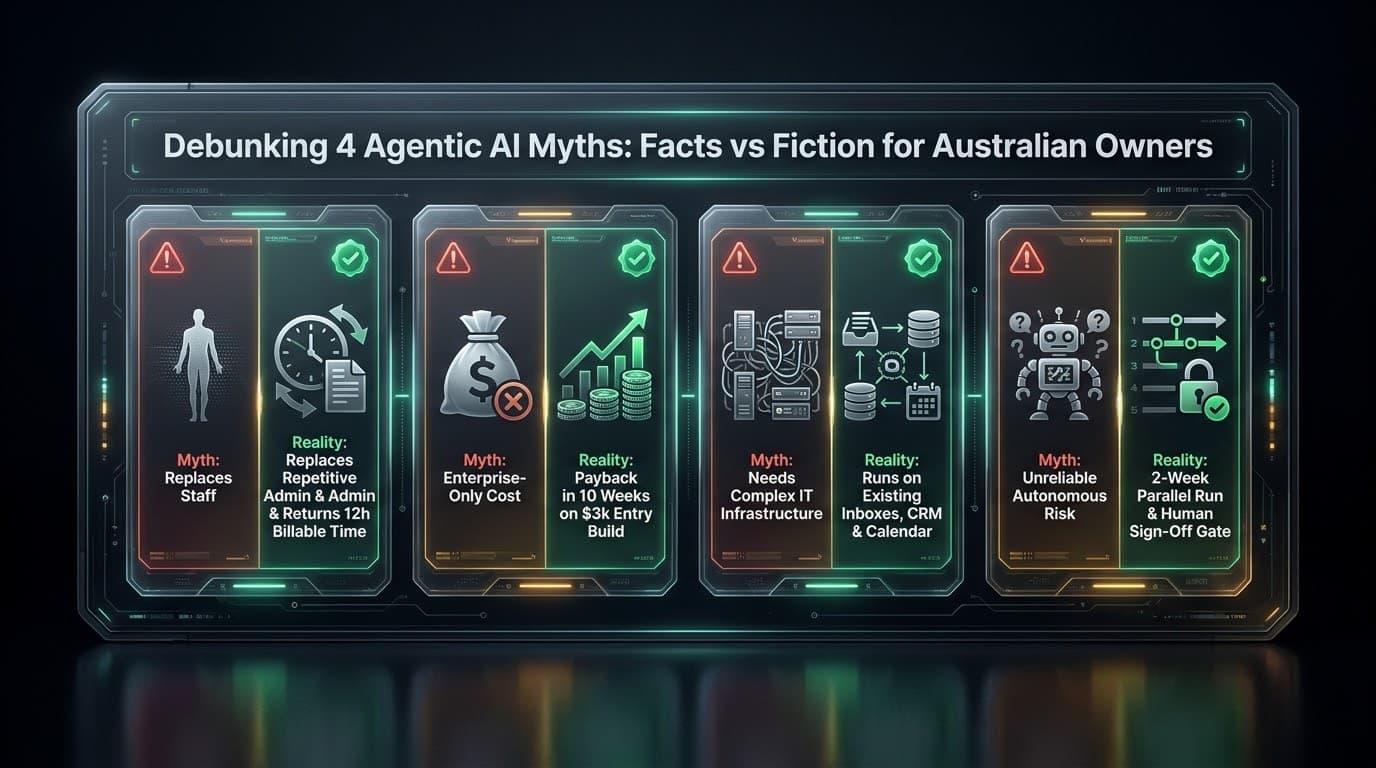
| Agentic AI is just a smarter chatbot | A chatbot produces a response. An agentic AI system sequences actions, calls APIs, updates records, and makes decisions across multiple steps without a human prompt between each step. |
| Generative AI and agentic AI are the same thing | Generative AI generates content in response to a single prompt. Agentic AI uses generative AI as its reasoning engine but adds memory, tools, and an action loop on top. |
| You need to replace all your tools before trying agentic AI | Agentic AI connects to your existing tools (Xero, HubSpot, Shopify, Google Workspace) via their APIs. You start with what you have, not a clean slate. |
| Agentic AI will replace all your staff | Agentic AI automates specific, defined, repeatable processes. It performs poorly on tasks requiring human judgement, novel contexts, relationship trust, or unstructured exceptions. |
How Agentic AI Works: The Architecture Explained
Understanding how agentic AI works starts with the four-layer architecture that underpins every production AI agent orchestration framework, from LangGraph to CrewAI to the OpenAI Agents SDK. These four layers are universal: they apply regardless of which framework or model you use. Understanding them gives you enough technical grounding to hold an informed conversation with a vendor or consultant, evaluate claims made about specific tools, and understand where in the stack a problem is occurring if something goes wrong.
The four-layer agentic AI stack
- Reasoning Engine. The LLM (Anthropic Claude, OpenAI GPT-4 or GPT-5, or Google Gemini) that interprets context, plans actions, and decides what to do next. The LLM is the brain of the system: it receives a description of the current state and a goal, and it works out the next step to take. The quality of the foundation model matters here. Different models have different strengths in planning, instruction-following, and tool use.
- Tool Layer.The APIs, integrations, and function calls the agent uses to act: email sending, CRM updates, database queries, file reads and writes, calendar bookings, and downstream workflow triggers. The tool layer is where the agent's reasoning becomes real-world action. Each tool must be explicitly granted to the agent; tools the agent has not been given access to cannot be used (this is the basis for the least-privilege security principle discussed in the governance section).
- Memory Layer. Short-term context (the conversation or session window) and long-term memory (vector databases such as Pinecone, Weaviate, or pgvector) that allow the agent to remember prior actions, user context, and historical patterns. Memory is what makes agentic AI capable of handling recurring tasks that build on prior runs. Without memory, every session starts from scratch.
- Orchestration Loop. The runtime layer (LangGraph, CrewAI, AutoGen, or the OpenAI Agents SDK) that manages agent flow, task routing, and inter-agent communication. The orchestration layer controls when the agent perceives, when it reasons, when it acts, and when it stops. In multi-agent systems, the orchestration layer manages which agent does what and in what order.
For a deeper comparison of tools in each layer, see our agentic AI tools comparison for Australian businesses and our broader look at best AI tools for 2026.
Single agent vs multi-agent systems
A single-agent system uses one AI agent to complete a task from start to finish. This is appropriate for most first deployments by Australian SMBs: the agent has a clear goal, a defined set of tools, and a single execution path. Single-agent systems are easier to build, easier to monitor, and easier to audit when something goes wrong.
A multi-agent system uses multiple AI agents in coordination: one agent might research a topic, another drafts a document based on that research, and a third reviews the draft for compliance. Multi-agent systems are relevant when different tasks within a workflow require different specialisations, or when a workflow is complex enough that a single agent cannot hold all required context within its window. For most businesses with 1-19 staff, a multi-agent system is not the right starting point.
The main agentic AI frameworks compared
The orchestration layer is implemented using one of several frameworks. The LangGraph vs CrewAI for Australian business question is the one we hear most often from SMB founders: both are capable, but they suit different deployment shapes. Here is an honest comparison that also covers multi-agent AI orchestration options for Australian SMB audiences.
| Framework | Best for | AU SMB suitability | Key strength | Key limitation |
|---|---|---|---|---|
| LangGraph | Stateful, complex multi-step workflows | Medium (requires engineering resources) | Fine-grained control of agent state and flow | Higher implementation complexity |
| CrewAI | Multi-agent role-based collaboration | Good for structured team-style agents | Easy to define agent roles and tasks | Less flexible for dynamic decision trees |
| AutoGen | Research, conversational multi-agent systems | Lower (research-grade, less production-hardened) | Strong for autonomous back-and-forth agent dialogue | Less suited for production SMB deployments |
| OpenAI Agents SDK | OpenAI-first deployments | Good if using GPT-4 or GPT-5 as the model | First-party support and documentation | Model lock-in to OpenAI ecosystem |
What the MCP protocol means for your business
MCP, the Model Context Protocol, is an open protocol announced by Anthropic in late 2024 that standardises how AI agents connect to external tools and data sources. The MCP protocol AI agents use is a common question: what is it, exactly? The simplest explanation is that it is the USB port for AI agents. Instead of building a custom integration for every tool, an MCP-compatible agent can connect to any MCP-compatible tool via a standard interface. For Australian businesses, this means that as more platforms (including Xero, HubSpot, Google Workspace, and others) publish MCP-compatible connectors, the cost and complexity of integrating agentic AI into your existing toolset reduces materially. You are not locked into a specific vendor's integration choices. Full documentation is available at modelcontextprotocol.io (Anthropic).
Agentic AI Use Cases: Real Australian Business Examples
Agentic AI use cases Australia 2026 show a clear pattern: the clearest returns come from processes that are high-frequency, rule-based, and currently consuming skilled staff time. AI agents for small business Australia are no longer experimental: agentic AI for small business is now the most common entry point for teams with 5-20 staff who have a documented, repeatable workflow eating into their week. Here are the use cases with the most traction, each with a realistic illustrative scenario. For a full library of AU-specific use cases, see our use cases library for Australian teams. For help deciding which AI function to build first or choosing which process to automate, we have dedicated guides for both.
Lead qualification and follow-up automation
An agentic AI system can read inbound enquiry messages, classify them by urgency and fit against an ideal client profile, draft a personalised holding or follow-up response, route the enquiry to the right team member with a context summary, and log the interaction in the CRM, all without a human reviewing each step.
A professional services firm with six staff was manually triaging 40-plus inbound enquiry emails per week, consuming 3-4 hours across the sales and admin team. After deploying an agentic AI workflow, inbound messages are classified by urgency, matched against the firm's ideal client profile, and the relevant team member is notified with a draft response ready for review. Unqualified leads receive an automated holding reply. (Illustrative example.)
Invoice and document processing
Agentic AI invoice processing small business Australia is one of the highest-ROI entry points: the agent reads incoming invoices (from email attachments or shared drives), extracts key fields (vendor, amount, due date, line items), cross-references against purchase orders or approved vendor lists, flags mismatches for human review, and pushes confirmed matches to Xero or MYOB for approval. The agent handles the extraction and matching; a human reviews exceptions.
A logistics company with 12 staff was manually matching supplier invoices to purchase orders across three email inboxes. The agentic AI workflow reads incoming invoices, extracts key fields, cross-references the purchase order database, flags mismatches for human review, and pushes confirmed matches to Xero for approval. (Illustrative example.)
Customer service triage
An agentic AI customer service triage workflow reads incoming support requests, classifies them by type and urgency, looks up the customer's account history, drafts a first response, and routes complex cases to the right team member with a summary. Routine requests (order status, booking confirmation, policy queries with clear answers) can often be resolved entirely by the agent. Complex or sensitive cases are escalated to a human with context already assembled.
An e-commerce business with eight staff was spending 15-plus hours per week responding to routine customer enquiries about order status and returns. After deploying an agentic AI triage workflow, routine queries are resolved automatically from order data, complex cases are escalated with full context, and the customer service team focuses on escalations and relationship-sensitive interactions only. (Illustrative example.)
Internal knowledge lookup
Agentic AI can serve as an internal knowledge assistant: searching across documentation, policy files, past proposals, and team notes to answer questions from staff without requiring a senior team member to be interrupted. This use case requires a well-organised knowledge base and a clear scope (the agent only answers from indexed documents, not from the open web) to remain reliable.
Works with the tools you already use (Xero, HubSpot, Shopify)
Does agentic AI work with Xero Australia? Yes. Does it work with HubSpot, Shopify, and MYOB? Also yes. A common question from Australian businesses is whether agentic AI requires replacing their current toolset. The answer is no.
- Xero. Via the Xero API or an MCP connector, agents can read invoice data, push entries, trigger approval workflows, and query account balances. Integration is well-documented and widely used.
- HubSpot. Contact updates, deal stage moves, task creation, and email sequence triggers can all be executed by an agent via the HubSpot API. This is one of the most common integrations for lead qualification workflows.
- Shopify. Order processing, inventory checks, product data enrichment, and customer enquiry routing are all supported via the Shopify API. Agentic AI can also connect to MYOB, Salesforce, Google Workspace (Gmail, Drive, Calendar), Slack, and WhatsApp Business via their respective APIs.
A caveat: integration complexity varies. Not all integrations are plug-and-play. Some require custom connector development or authentication setup that is not trivial for non-technical teams. A readiness assessment will identify which of your current tools have accessible APIs and flag any gaps before you commit to a build.
Industry verticals gaining early traction
Certain sectors are seeing earlier adoption of agentic AI in Australia, primarily because they have high-frequency, rule-based administrative workflows that sit alongside their core professional work.
- Fintech and financial services. Agentic AI use in fintech Australia 2026 centres on loan pre-qualification, compliance document review, anomaly flagging in transaction data, and client onboarding workflows.
- Healthcare administration (non-clinical). Appointment scheduling, referral triage, patient intake form processing, and insurance pre-authorisation follow-up. Note: all healthcare use cases must be framed as administrative workflow only. Agentic AI does not make clinical or diagnostic decisions.
- Logistics and supply chain. Order status lookup, exception flagging, carrier communication, and proof-of-delivery tracking.
- E-commerce and retail. Abandoned cart follow-up, returns triage, product data enrichment, and supplier communication.
Enterprise AI adoption Australia is accelerating across these verticals, with larger organisations moving from pilot programs to production deployments at a faster pace than the SMB cohort, primarily because they have dedicated data engineering capacity to clear the integration foundations that small teams must prepare before deploying.
Agentic AI Cost in Australia: Honest Pricing
Most content about agentic AI costs either avoids the topic entirely or offers ranges so wide they are useless for planning. This section gives you Bizkook's actual pricing, an agentic AI total cost of ownership breakdown, and an honest look at agentic AI ROI small business Australia context. The agentic AI build cost vs buy cost Australia question is also addressed: building a custom workflow has a different risk and flexibility profile from buying a packaged SaaS tool, and both options have different TCO implications. For a broader view of AI consulting investment, AI consulting costs in Sydney covers the market context, and unit economics of an AI employee gives a framework for thinking about the return.
What you are actually paying for
An agentic AI deployment has four cost categories that most businesses do not account for upfront.
- LLM API costs. Charged per token by the model provider (Anthropic, OpenAI, Google). For SMB-level usage, expect $20-$200 per month depending on workflow volume and which model is selected. Higher-capability models cost more per token.
- Hosting and infrastructure. Agentic workflows need a runtime environment. For SMB deployments on cloud providers (AWS, Google Cloud, Vercel), expect $20-$80 per month depending on usage.
- Development cost.The build engagement covers scoping, building, testing, integrating, and handing over the workflow. Bizkook's pricing is listed in the table below.
- Monitoring and iteration. Ongoing cost to monitor for errors, handle exceptions, and iterate on the workflow as your business processes change. This is typically underestimated in initial planning.
Development is typically only 25-35% of the three-year total cost of ownership for an agentic AI deployment. The majority of cost comes from LLM APIs, hosting, and ongoing iteration. Being clear about this upfront is more useful to your planning than an optimistic build-cost figure followed by unexpected ongoing costs.
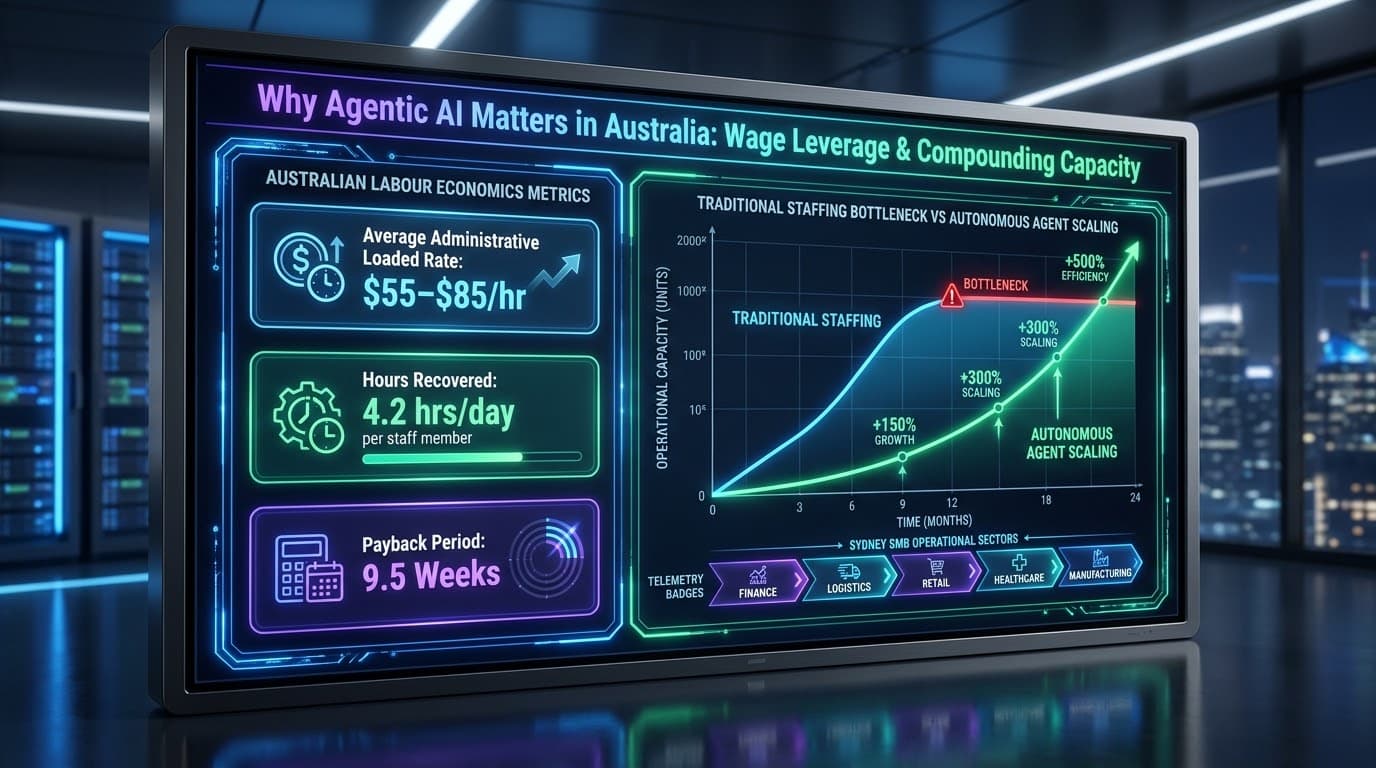
Bizkook's three engagement tiers
| Tier | What it covers | Investment |
|---|---|---|
| Readiness Assessment | 60-minute structured review of your processes, data readiness, and highest-ROI automation opportunities. Documented output with a prioritised recommendation. | $300 |
| Single Workflow Build | Design, build, test, and handover of one end-to-end agentic AI workflow (for example, lead qualification, document processing, or customer triage). Includes integration with your existing tools. | From $3,000 |
| Ongoing Retainer | Monthly monitoring, iteration, and expansion of deployed workflows. Includes new workflow scoping each quarter. | $200 per month |
Total cost of ownership beyond the build
Understanding agentic AI monthly operating costs Australia requires looking beyond the development invoice. The McKinsey Global Institute's 2026 AI report documents AI ROI benchmarks for enterprise-scale deployments. These are global enterprise figures, not Australian SMB-specific outcomes, but they establish a directional basis for thinking about return. The principle that holds across scales is this: AI investment returns through time recovered, error reduction, and capacity freed for higher-value work, not through reducing headcount. An honest assessment of whether your specific workflow justifies the investment depends on how much skilled staff time that workflow currently consumes and what those staff members could do with that time instead.
When does the investment make sense?
A workflow is worth automating when it happens more than 20 times per week, follows consistent rules with defined inputs and outputs, and currently consumes 5 or more hours of skilled staff time per week. A workflow is not yet worth automating when inputs are highly variable and unstructured, exception rates exceed roughly 30%, or the process changes frequently.
Timing also matters for budget planning. Agentic AI seasonal budget planning Q4 Australia is the primary investment window: October-November is when most businesses lock AI spend ahead of the new financial year. The new financial year (July) is the second planning window. The December 2026 commencement of the Privacy Act automated decision-making transparency provisions creates a third, compliance-specific urgency window for businesses that have not yet reviewed their governance position.
Not sure whether the investment is right for your business? The AI Tune Score maps it.
Five minutes. Find out where your biggest automation opportunities are and whether your business foundations are ready for agentic AI.
Agentic AI Governance and Compliance: What Australian Businesses Need to Know
Governance is the section most AI content skips. This one does not. Agentic AI Privacy Act 2026 Australia compliance is now a specific obligation, not a theoretical concern. If your agentic AI system uses personal information about Australians to make or assist with decisions, you have obligations under Australian law. The Governance Institute Australia agentic AI 2026 guidance, alongside OAIC and the Department of Industry, Science and Resources frameworks, provides the reference architecture for organisations mapping their compliance position. For a full governance guide, see our governance and compliance guide for Australian businesses.
This section is for general education only. It does not constitute legal or compliance advice. For specific obligations, consult your legal adviser or the Office of the Australian Information Commissioner at oaic.gov.au. OAIC guidance on the December 2026 automated decision-making provisions is actively being updated. Check oaic.gov.au/privacy/privacy-act-reform for the latest guidance at the time you are reading this.
Australia's automated decision-making transparency rules
The Privacy Act 1988 (Cth) governs how Australian businesses collect, use, and disclose personal information. The Privacy and Other Legislation Amendment Act 2024 (Cth) amended the Privacy Act to introduce new automated decision-making transparency requirements. The Privacy Act automated decision-making disclosure Australia requirement sits under Australian Privacy Principle 1 (APP 1): privacy policies must now disclose automated decision-making processes that use personal information. The commencement date for these provisions is December 2026. Current OAIC guidance is at oaic.gov.au/privacy/privacy-act-reform.
To be precise about what these provisions require: they are transparency and disclosure requirements, not a prohibition on automated decision-making. If your business deploys an agentic AI system that uses personal information about Australians to make or assist with decisions (lead scoring, customer routing, document classification), you are required to disclose this in your privacy policy and to describe how that automated decision-making operates. Most Australian businesses deploying agentic AI in 2026 have not yet completed this privacy policy review.
Human-in-the-loop design: what it means in practice
How to implement human-in-the-loop AI Australia is one of the most practical questions we address in every engagement. Human-in-the-loop (HITL) means a human reviews and approves agent actions at defined checkpoints before those actions have real-world consequences. The principle is not that every action requires human approval: that would eliminate the efficiency gains. The principle is that the higher the consequence of an error, the earlier and more frequent the human checkpoint should be.
Common HITL checkpoints in Australian SMB deployments: email draft approval before the message is sent; invoice match approval before an entry posts to Xero; contract clause flagging before a document is released; customer communication approval before a message goes to a client in a sensitive situation. Bizkook designs HITL into every workflow by default at the start of a deployment. Reducing human oversight is a decision made after the workflow has demonstrated reliability, not before.
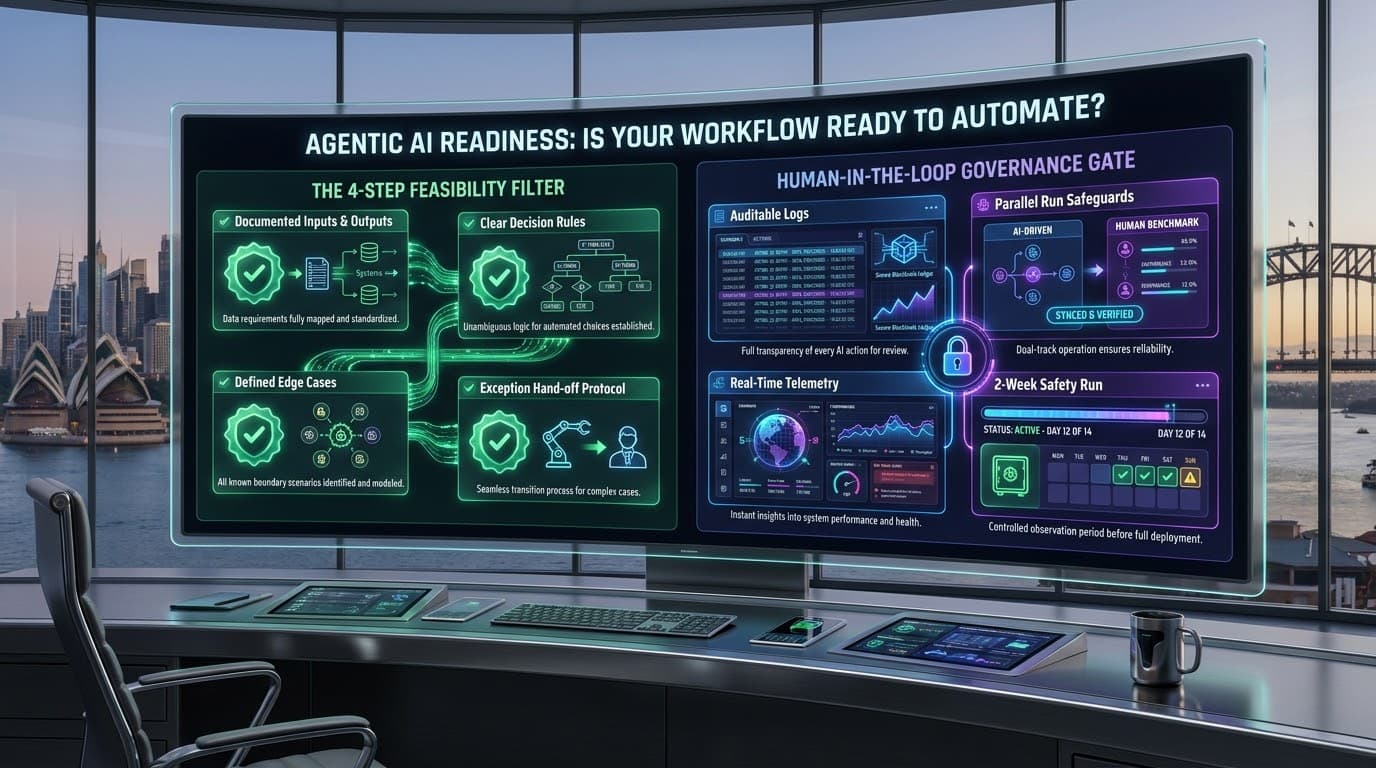
Graduated autonomy: the phased deployment model
Graduated autonomy means starting with full supervision (every agent action reviewed by a human), progressing to semi-supervised (only exceptions reviewed), and only reaching unsupervised operation for low-stakes, high-volume, well-tested workflows after an established track record. The progression is: Supervised, then Semi-supervised, then Unsupervised. Each step forward requires a defined review period and a measurable error rate that falls below a pre-agreed threshold. A business should not deploy unsupervised agentic AI in the first 90 days of any new workflow.
Cybersecurity and prompt injection risk
Agentic AI cybersecurity risk Australia is well-documented: prompt injection is the primary attack vector specific to agentic AI systems. An attacker embeds malicious instructions in content the agent processes (a PDF, an email, or a webpage), causing the agent to take unauthorised actions (forwarding sensitive data, modifying records, or executing unintended commands). The defence is a combination of input sanitisation, strict tool permissions, and output monitoring. The least-privilege principle applies directly: the agent should only have access to the tools, data, and permissions required for its defined task. Broad system access is not appropriate for agentic AI deployments.
On data sovereignty: personal data about Australians should ideally be processed in Australian-region data centres or under an Australian Data Processing Agreement. The Australian Signals Directorate and its international partners (including CISA and NCSC) have published joint guidance on secure AI adoption at cyber.gov.au. This is the primary reference for security posture controls in Australian agentic AI deployments.
The key governance frameworks Australian businesses should know
| Framework | Type | Administered by | Relevance to AU businesses |
|---|---|---|---|
| Privacy Act 1988 (Cth) · Amendment Act 2024 | Statutory, mandatory | OAIC (oaic.gov.au) | Any agentic AI processing personal information of Australians |
| AI Ethics Principles (2019, updated 2023) | Voluntary guidance | Dept of Industry, Science and Resources (industry.gov.au) | All organisations; increasingly referenced in enterprise procurement and vendor evaluation |
| Voluntary AI Safety Standard 2024 | Voluntary guidance | Dept of Industry, Science and Resources (industry.gov.au) | All organisations; enterprise and government-adjacent use cases |
| EU AI Act (2024) | Statutory, mandatory for EU market | European AI Office | AU businesses with EU market presence or EU data subjects; useful risk-tier model for all |
| cyber.gov.au AI Adoption Guidance | Non-statutory guidance | Australian Signals Directorate (asd.gov.au) | All businesses; security posture for agentic AI deployment |
Note on voluntary status: the AI Ethics Principles and Voluntary AI Safety Standard 2024 are explicitly voluntary instruments. Any framing that implies mandatory compliance with these documents would be inaccurate. Their relevance is real but different: they are the standards that enterprise procurement teams and government-adjacent organisations increasingly use to evaluate AI vendors and partners.
How to Implement Agentic AI in Your Australian Business
Agentic AI implementation Australia requires a sequenced approach: the tool choice matters less than the adoption order. This five-step model functions as an AI workflow automation checklist Australia SMB teams can follow regardless of which framework they select. It also maps to the agentic AI implementation checklist for small business that Bizkook uses in every engagement. For a fuller treatment of AI workflow automation Australia context, see our step-by-step implementation checklist.
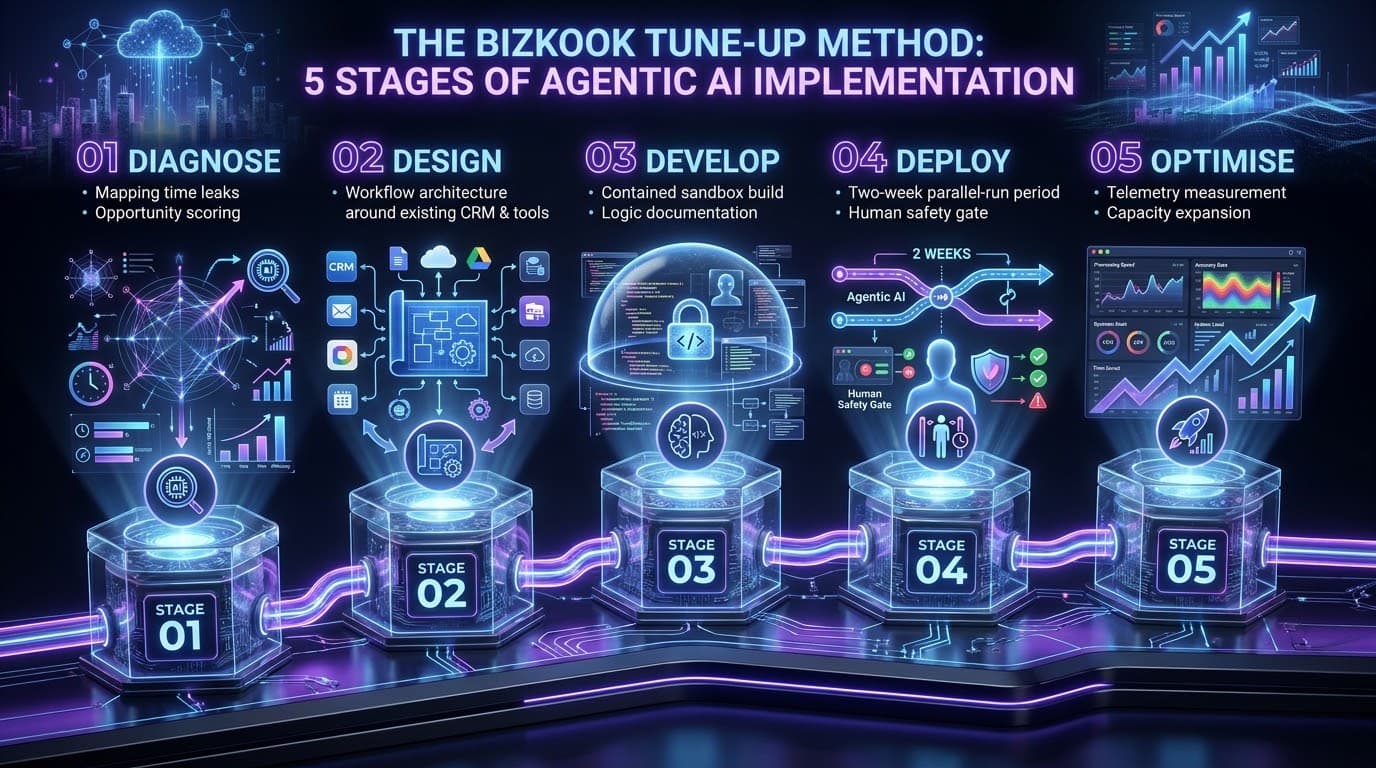
- Step 1: Map your high-impact, repeatable processes. Look for processes that are high-frequency (at least weekly), rule-based with defined inputs and outputs, currently consuming significant skilled staff time, and where errors have manageable consequences. The best first candidates are processes where the steps are already documented or could be documented in an afternoon. Examples: inbound email triage, invoice matching, lead qualification, appointment scheduling. Avoid processes where the rules change frequently or where more than 30% of cases require judgement that is hard to define.
- Step 2: Assess your data and integration readiness. Agentic AI needs structured or semi-structured data inputs. Before scoping a build, check: do you have clean, accessible data in the systems the agent needs to connect to? Are your Xero, HubSpot, or Shopify accounts accurate and up to date? Do those accounts have API access tokens available? Data readiness is consistently the most time-consuming part of a deployment. MIT Sloan's analysis of agentic AI adoption notes that data engineering accounts for 80% of implementation effort for most first deployments.
- Step 3: Choose your deployment tier. Single-agent first. One workflow and one integration before adding multi-agent complexity. The scope and cost of your first build should reflect what you actually know about your processes and data, not what you hope to achieve in twelve months. Bizkook's $300 readiness assessment outputs a specific workflow recommendation and a defined scope. It is the lowest-risk way to answer the question “where should we start?” before committing to a build investment.
- Step 4: Design human-in-the-loop checkpoints. Before you build, define: what decisions need human approval? What is the approval mechanism (email notification, Slack message, dashboard review)? What happens if the human does not respond within a defined time window? Does the agent wait, escalate, or fail safely? HITL design should happen before development begins, not after the workflow is already running and an error has occurred. Guidance from cyber.gov.au supports this approach for deployment security.
- Step 5: Pilot, measure, and expand. Run the first workflow for 30-90 days with full monitoring. Measure: error rate (how often does the agent produce output that requires correction), exception volume (how often does the agent hit a case it cannot handle), staff time saved (is the time saving real and measurable), and user satisfaction (does the team trust the system). Only expand scope once the first workflow is stable and understood. The businesses that report the best outcomes from agentic AI are consistently those that started small, measured carefully, and expanded deliberately.
Not sure where to start? A readiness assessment answers that question.
60 minutes. A structured review of your processes, data, and tools, with a written recommendation on where to start. $300 fixed price, applies to your build if you proceed.
Is Agentic AI Right for Your Business?
Agentic AI is not right for every business at every stage. The question of how to know if your business is ready for agentic AI has a structured answer: the signals below help you self-assess without a sales conversation. The Bizkook agentic AI readiness assessment (described at the end of this section) gives a formal verdict in 60 minutes. For a free 5-minute structured signal, the agentic AI readiness assessment Australia shortcut is the AI Tune Score below.
Signs your business is ready for agentic AI
- You have at least one process that happens more than 20 times per week and follows consistent rules
- Your team spends more than 5 hours per week on manual data entry, routing, or triage
- You are already using cloud-based tools (Xero, HubSpot, Google Workspace, Shopify) with API access
- You have a clear owner who will manage the AI workflow and handle exceptions
- You are comfortable with a supervised pilot before full deployment
Signs you need to build foundations first
- Your core business processes are undocumented or highly variable
- You are still setting up your CRM, accounting system, or data infrastructure
- Your team has no capacity to manage a pilot or review agent outputs
- You are expecting agentic AI to replace strategic thinking or relationship management
- Your data is siloed across disconnected systems with no API access
What a readiness assessment covers
A readiness assessment is a structured 60-minute review of your processes, data sources, existing tools, and team capacity. The output is a prioritised list of automation opportunities ranked by impact and implementation difficulty, along with an honest assessment of whether your foundations are in place. It covers security posture as well: understanding the agentic AI prompt injection attack explained in plain English, and whether your planned integrations expose you to that risk, is part of the scoping conversation. It is the lowest-risk way to answer “should we do this?” before committing to a build investment. Bizkook's assessment is fixed at $300 and that cost applies to the build investment if you proceed.
Two options depending on where you are.
Not sure yet? Take the free 5-minute AI Tune Score and find out where your automation opportunities sit. Ready to scope it? Book a free 15-minute discovery call. No pitch, just a plain-English conversation about your business.
Agentic AI Consulting in Sydney and Across Australia
Bizkook provides agentic AI consulting Australia for businesses ready to deploy their first workflow. As an AI automation consultant Sydney-based with national reach, Bizkook designs, builds, and hands over agentic AI workflows integrated with your existing tools. For founders looking to hire agentic AI consultant Australia, AI consulting Sydney small business context, or guidance on agentic AI Sydney 2026 engagements, the first step is a readiness assessment. For guidance on how to choose an AI consultant in Australia, we have a separate guide that covers what to look for, what questions to ask, and what a well-scoped engagement should include.
What an agentic AI engagement looks like
Bizkook works with Australian businesses with 1-19 staff and with growth-stage teams (20-100 staff) exploring their first agentic AI deployment. Engagements start with a structured readiness assessment, not a sales pitch. Every build includes integration with your existing tools, documented HITL checkpoints, and a handover so your team can manage and monitor the workflow after delivery. Bizkook works nationally and with Australian businesses operating across Australia and New Zealand. Businesses seeking AI agent consulting Brisbane and Queensland teams can engage Bizkook remotely with the same structured assessment and documented build process as Sydney-based clients. For agentic AI Melbourne business 2026 enquiries, Bizkook runs remote-first engagements across Victoria with the same structured assessment and build process as Sydney-based clients.
Bizkook's three tiers
- Readiness Assessment: $300. Map your automation opportunities and check your foundations before committing to a build. Documented output with a prioritised recommendation.
- Single Workflow Build: from $3,000. One end-to-end agentic AI workflow designed, built, tested, and handed over with integration to your existing tools.
- Monthly Retainer: $200 per month. Ongoing monitoring, iteration, and quarterly new workflow scoping as your business evolves.
Who we work with
Professional services firms, trades businesses, e-commerce operators, health administration practices, and logistics businesses with 1-19 staff. Growth-stage businesses (20-100 staff) looking to automate their first function before scaling. Enterprise teams (100-plus staff) evaluating a specific workflow for a pilot. Agentic AI New Zealand business clients with Australian market presence also work with Bizkook nationally. To book AI readiness assessment Sydney or remotely across Australia, the starting point is the $300 readiness assessment. The common thread is not industry or size: it is having a specific, high-frequency process that is costing skilled staff time and where a well-designed agentic AI workflow can return that time durably.
Ready to talk about your specific situation? Book a call.
No obligation, no pitch. A plain-English conversation about your business and whether agentic AI makes sense for where you are right now.
Frequently Asked Questions About Agentic AI in Australia
Watch: agentic AI in six minutes
The Bizkook team walks through the agentic AI loop, use cases across business functions, tools comparison, and the 5-step implementation on real Australian SMB workflows. Same method as above, worked out loud.
 6:45
6:45Chapters
- 0:00What agentic AI is (and what it isn't)
- 1:00Perceive, Reason, Act, Learn: the loop
- 2:15Six use cases by business function
- 3:30Tools and framework comparison
- 4:40Governance under the Voluntary AI Safety Standard
- 5:45How to start: the 5-step implementation
In summary
Agentic AI is not chat. It's a system that pursues a goal through multiple steps with delegated autonomy and human oversight where risk matters. Start with one workflow, get it running well, then add the next. Governance stays with the human, always.
Get your AI Tune ScoreCommon questions
Answered directly, so they can be quoted without the surrounding argument.
Generative AI produces content (text, images, code) in response to a single prompt and then stops. Agentic AI uses a generative AI model as its reasoning engine, but adds a memory layer, tool access, and an action loop on top, allowing it to complete multi-step tasks without a human prompt between each step. The simplest way to think about it: generative AI is a highly capable assistant that answers questions; agentic AI is a system that completes jobs.
How this piece was produced
Written by the Bizkook team based on direct experience implementing AI workflows for Australian businesses. Regulatory references cite the Privacy Act 1988 (Cth), the Privacy and Other Legislation Amendment Act 2024 (Cth), the AI Ethics Principles and Voluntary AI Safety Standard 2024 published by the Department of Industry, Science and Resources (industry.gov.au), guidance from the Australian Signals Directorate (cyber.gov.au), and the Office of the Australian Information Commissioner (oaic.gov.au). Framework references cite LangChain documentation (langchain.com), CrewAI documentation (crewai.com), Anthropic MCP documentation (modelcontextprotocol.io), and the AWS agentic AI overview (aws.amazon.com). McKinsey Global Institute 2026 AI report cited for directional enterprise-scale benchmarks. Reviewed and edited by the Bizkook team before publication. Last updated: September 2026.